Managing supplier performance is a priority for Procurement teams. And for good reason: supplier performance is not an end in itself, it directly determines the overall performance of the procurement function.
This is precisely the challenge addressed by a Vendor Management System (VMS), a key component of the Source-to-Pay cycle. By centralizing data and structuring performance management around key performance indicators, it enables procurement teams to move from a reactive approach to true strategic management. The market is rapidly expanding, estimated at $10.4 billion by 2025 with a CAGR of 10.5%.
The question remains: which KPIs should you track, and how can they be used effectively on a daily basis?
Why is data essential for managing supplier performance?
François Tourrette, expert at BRAPI, puts it clearly: “A buyer is someone who manages risks. They need to understand their needs, their market, and the associated risks.”
Managing risks without structured data is like navigating blindly. KPIs are not just another reporting exercise. They are the foundation on which Procurement teams make informed decisions, anticipate budget overruns, and build supplier relationships based on objective facts.
In practice, this visibility helps identify the providers who truly create value, detect process inefficiencies, and benchmark rate cards against the market. It also protects the organization from often underestimated contractual risks, particularly when assignments approach critical duration thresholds that may expose the company to reclassification risks.
Three KPI levels to measure supplier performance
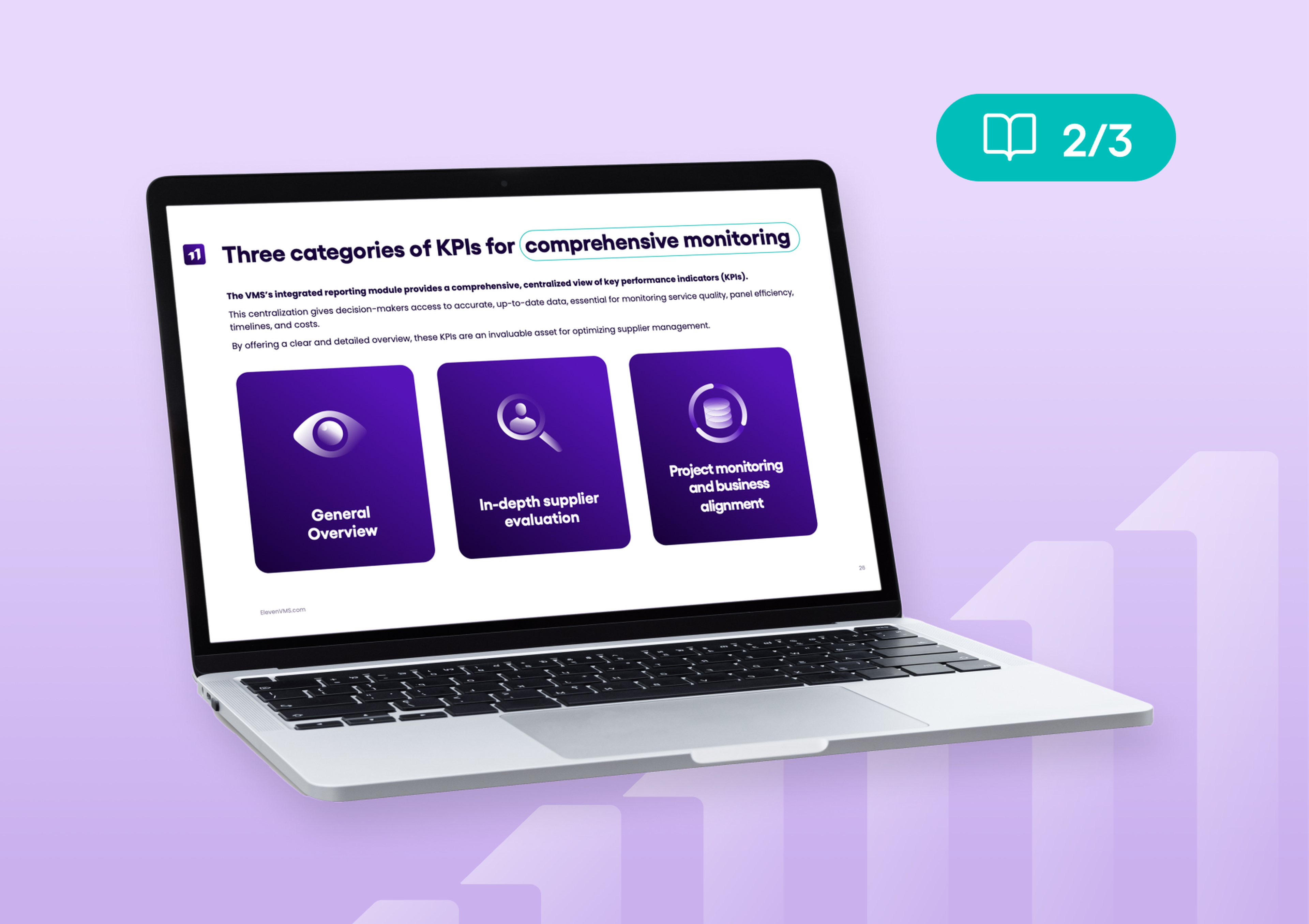
The reporting module of a VMS structures management around three complementary levels, each addressing a specific question.
The high-level overview provides a macro perspective of procurement activity: spend by period, average selection time from RFP publication to Purchase Order creation, average daily rate (ADR) by profile and location, and the distribution of needs by skill. These indicators enable the measurement of overall process efficiency and help identify levers for optimization across the organization.
Individual supplier assessment goes into the details for each provider: response rate to RFPs, proposal conversion rate, reasons for non-selection, adherence to rate cards, and sustainability criteria. This data allows for an objective ranking of the supplier panel and clearly identifies top-performing and underperforming providers by expertise. It forms the essential basis for any renegotiation, backed by concrete arguments.
Project tracking and business alignment ensure that the panel effectively meets operational teams’ needs and continuously complies with legal requirements. The VMS incorporates automated alerts for assignment durations, helping to identify risk situations before they become problems.
By centralizing these indicators on a single platform, procurement teams can reduce administrative management time by up to 40% — equivalent to an average of 150 hours saved or reinvested per year — while the VMS streamlines costs by 20–35% and accelerates approvals.
From monitoring to action: enhancing supplier performance through dynamic panel management
Measuring supplier performance only makes sense if the data drives decisions. This is the principle behind dynamic panel management: continuously adjusting your supplier panel based on observed results, rather than maintaining static lists that no longer reflect market reality.
In practice, this means continuously analyzing each supplier’s key indicators—quality, delivery times, and pricing competitiveness—to identify who is performing and who is falling behind. This analysis can be enriched with external market data, which is especially useful during renegotiations. High-performing suppliers solidify their place in the panel, while those that no longer meet expectations are removed and replaced with new providers identified via the platform.
The result: a streamlined panel reduced by 20%, strengthened strategic partnerships, improved negotiating power through volume consolidation among a smaller number of qualified suppliers, and far less time-consuming panel management processes.
Management that benefits all stakeholders
One of the often underestimated strengths of a VMS is its ability to align functions that rarely speak the same language. Dashboards are accessible in real time by Procurement, Finance, and Controlling teams—each finding the data they need without duplicate entries or scattered information.
For suppliers, the transparency of management also changes the nature of the relationship. They have access to their own performance indicators, understand the evaluation criteria, and can improve continuously. This clarity fosters longer-term collaborations and more consistent service quality—in a market projected to reach USD 23 billion by 2033.
Shared data, automated processes, fact-based decisions: it is this overall coherence that enables Procurement teams to play a truly strategic role within the company.
To go further and discover how to manage supplier performance with the right indicators, download the white paper “Why Implement a Vendor Management System" from Eleven VMS.