
As the use of external providers intensifies, large organizations are facing an explosion in the volume of professional services contracts.
These contracts, often low in value but critical for project execution, extend contracting timelines and turn time to contract into a major point of friction.
At scale, the current challenge is to enable fast execution without multiplying risks, exceptions, and workarounds.
It is precisely this tension between speed and control that contract management must now resolve.
Why contract management has become a point of friction at scale
Three signals indicate that contract management has become a constraint rather than a lever:
simple contracts take as much time as sensitive contracts,
2. business teams multiply “urgent” requests and exceptions,
3. procurement and legal functions spend most of their time on repetitive, low value-added cases.
At scale, contract management becomes a point of friction not due to excessive risk, but due to the accumulation of micro-decisions, validations, and controls designed for another context.
Contract management processes were often designed at a time when contracts were fewer, heavily negotiated, and treated as primarily strategic cases. This approach remains relevant for certain agreements, but quickly shows its limits when applied to recurring and standardizable engagements.
In many large organizations, the bottleneck is linked to the repetition of the same micro-decisions in sequence: who validates what, at what moment, on which template, with which documents. On paper, each step is justified. In practice, they accumulate and create an invisible queue, where simple matters take the place of truly sensitive ones.
The change of scale is not marginal
At scale, several structural evolutions accumulate. The number of providers increases, particularly in niche expertise areas. Business needs fragment, with a multiplication of short-term and ad hoc assignments. Expected timelines shorten, as projects follow one another and teams must deliver faster. At the same time, compliance requirements strengthen, mechanically increasing the number of controls and validations.
This change in dimension does not result from a simple increase in volume. It profoundly modifies the nature of contract management, which must now absorb a continuous flow of requests, heterogeneous in their usage but processed within frameworks often designed for much rarer situations.
When contract management becomes a bottleneck
Applied to this change of scale, uniform contractual processes create structural slowdown. Contract management gradually ceases to be perceived as a useful safeguarding mechanism and becomes an operational bottleneck. Projects are delayed before they even start, business teams become discouraged and look for shortcuts, buyers spend disproportionate time managing individual cases, and legal teams are solicited on repetitive, low value-added matters.
The most critical issue lies elsewhere. When contracting becomes too slow, the organization ends up creating exceptions to keep moving forward. These exceptions become habits. And these habits create growing exposure to risk.
This is often where the mechanism breaks down: one “urgent” assignment is prioritized, then another, then a third. The exception path becomes a parallel path, faster but less traceable. And after a few months, the organization no longer clearly knows which framework actually applies, nor which commitments have been made, by whom and under what conditions.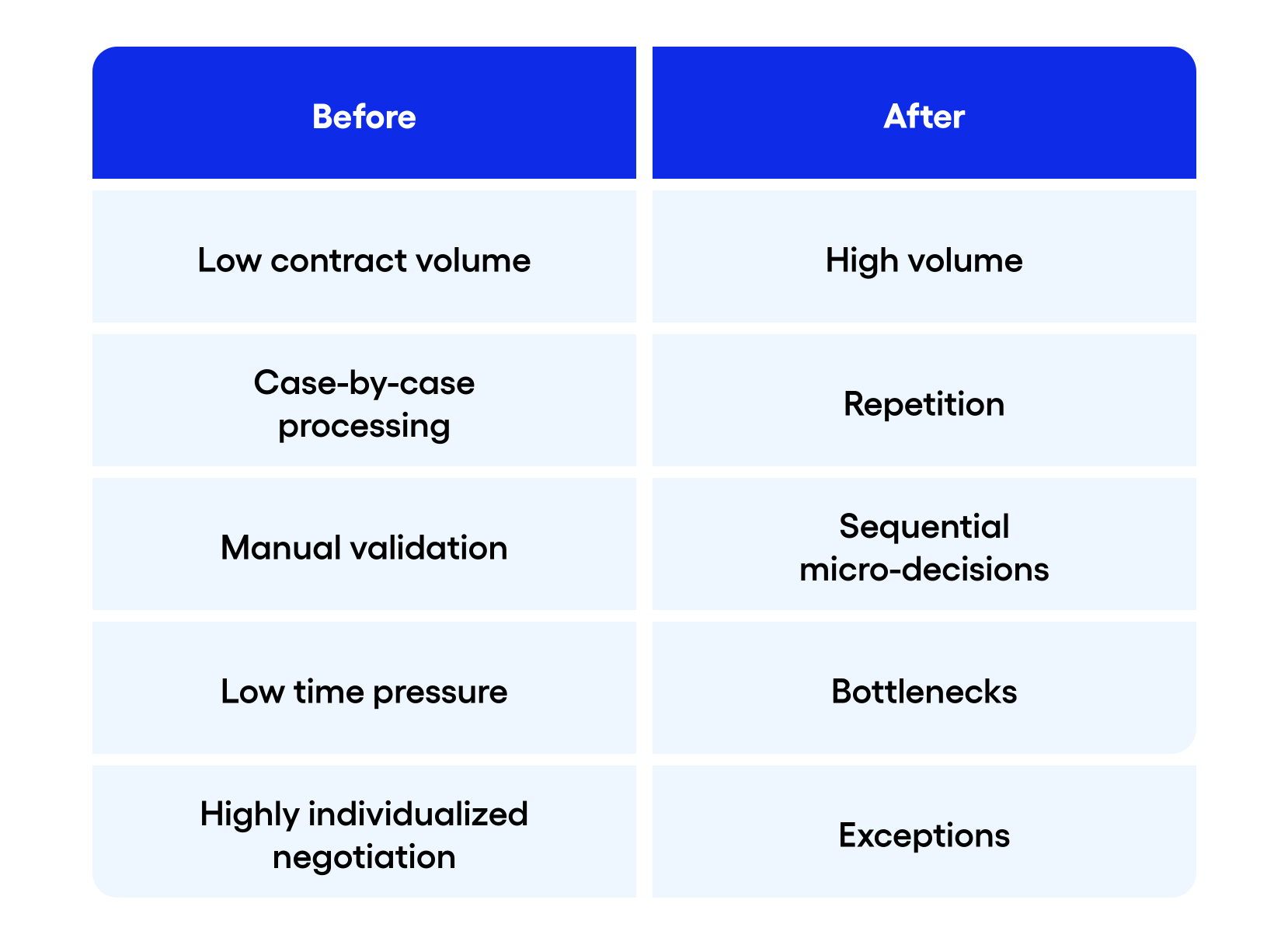
Services contract management: when volume becomes the real challenge
In service engagements, the contract management challenge is based on three cumulative factors:
a high volume of low-value contracts,
strong heterogeneity of uses and assignments,
risk exposure that is not limited to face value.
Services difficult to standardize in substance, but repetitive in form
Professional services rely on time-limited assignments, evolving scopes, and highly specialized expertise. In substance, deliverables and execution methods vary significantly. In form, however, contractual expectations repeat. Issues of confidentiality, intellectual property, obligations of means or results, liability, insurance, security, invoicing terms, or end-of-assignment conditions are systematically present.
The paradox is well known to procurement departments. Low-value contracts are those that proportionally consume the most administrative time. They are also those whose volume makes any manual management impractical.
Risk is not measured solely by face value
If low-value contracts already create an operational workload issue, they primarily create a risk qualification issue in a services environment. A low-value contract can expose the organization to significant risks, whether through access to sensitive information systems, processing of confidential data, dependency on critical expertise, poorly defined scope generating disputes, or documentary non-compliance blocking an invoice or exposing the company to audit risk.
This is precisely what traps organizations: a contract that is “small” in value can be “large” in exposure. A short assignment can provide access to a sensitive environment, involve critical data, or indirectly engage the company’s liability.
At scale, it is the combination of volume and heterogeneity of uses that creates complexity. Without a specific approach, services contract management quickly becomes unmanageable.
Time to contract: an underestimated but strategic indicator
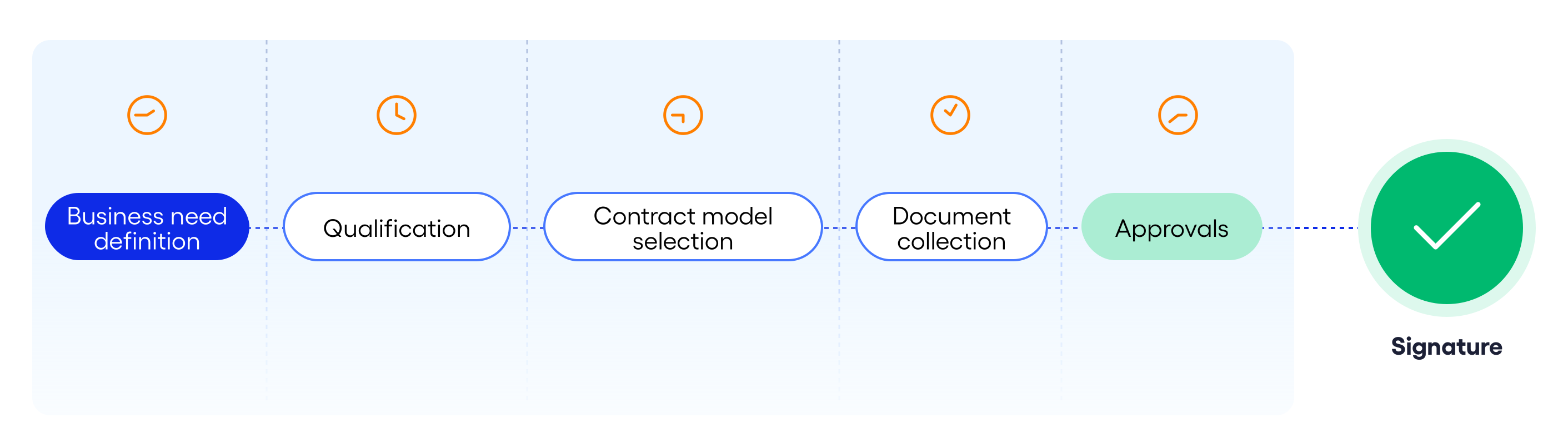
Time to contract refers to the period between the expression of a business need and the effective signature of the contract. At scale, it is not limited to a question of signature or legal validation. It constitutes a key indicator of an organization’s ability to transform an operational need into actual execution.
When this delay increases, impacts are immediate. Projects are delayed before they even start, business teams experience increased pressure, and procurement and legal functions are solicited for recurring urgencies. Time to contract then becomes a transversal point of friction, revealing deeper imbalances in contractual organization.
At this stage, the issue goes far beyond the question of delay alone. It highlights how contractual journeys are designed, the ability to absorb volume without creating exceptions, and the level of alignment between procurement, legal, and business teams. Time to contract is not an isolated cause, but the visible symptom of contract management confronted with a change of scale.
When contracting speed becomes a factor of operational performance and competitiveness, it deserves dedicated analysis. The structural causes of extended time to contract, as well as the levers to reduce it without increasing risk, are explored in a specific article dedicated to this topic.
Standardized contracts: a fundamental lever to scale
Contract standardization is often perceived as a constraint imposed on business teams. In reality, standardized contracts constitute an essential foundation to structure large-scale contract management of professional services.
What contract standardization truly changes
Standardizing does not mean rigidifying the contractual relationship, nor giving up legal security. It consists of defining validated contractual frameworks in advance, adapted to recurring use cases.
A well-designed contract standardization approach reduces review and validation timelines, limits back-and-forth between procurement, legal, and business teams, ensures contractual consistency across engagements, and strengthens traceability of obligations. It also creates a common foundation essential to implementing accelerated contracting journeys. To learn more about contract standardization, you can consult this dedicated article.
Fast track contracting: accelerating without improvising
Fast track contracting models respond to a specific need: quickly processing low-risk contracts within a previously secured framework.
When accelerated contracting is relevant
Accelerated contracting is only relevant if several conditions are met:
a standardized and validated contractual framework,
clear upfront risk qualification,
explicit thresholds and governance rules,
traceability of decisions.
Frequent mistakes
Recurring pitfalls are well identified: accelerating without segmenting and treating all contracts as if they were similar, accelerating without governance in the absence of clear thresholds, or attempting to save time only at the end of the chain, at the time of signature, without rethinking the entire process. Fast track contracting works when it is embedded in a stable operating model, not as a permanent exception.
A typical case: an attempt is made to “save time” at the signature stage, whereas the slowdown occurred much earlier (needs qualification, template selection, document collection, validations). Result: the signature is rushed, quality deteriorates, and unresolved points reappear later as disputes, amendments, or invoice blockages.
Contract enablement and contract delegation: changing the paradigm
What contract enablement truly covers
Contract enablement is based on contractual models adapted to use cases, clear validation paths, controls positioned upstream on documentation and compliance, and traceability of decisions. The objective is to enable fast execution without systematically depending on manual intervention from legal or procurement.
In practice, contract enablement translates into a shift in posture of central functions, where the goal is to design a framework robust enough so that the majority of cases can be handled autonomously. This implies thinking of contractual journeys as execution journeys, with simple rules, accessible templates, and explicit checkpoints. Business teams gain autonomy, procurement refocuses on steering and consistency issues, and legal concentrates on truly sensitive matters.
Delegating without losing control
Contract delegation, or delegated contracting, corresponds to an intelligent distribution of responsibilities. This model assumes clearly defined roles, documented delegation thresholds, non-negotiable safeguards, and escalation mechanisms for out-of-standard cases. Well executed, delegation reduces the burden on central teams while maintaining a high level of compliance.
Contract consolidation: regaining control at scale
As the number of contracts increases, the risk of fragmentation becomes critical. The multiplication of counterparties, heterogeneity of documents, and absence of consolidated visibility make contractual steering unreadable.
What contract consolidation aims to achieve
Contract consolidation aims to centralize relevant information, harmonize practices, and offer a transversal view of contractual commitments. In a services contract management context, it constitutes a steering foundation rather than a simple administrative project, by enabling identification of risk areas, inconsistencies, and sources of inefficiency.
Controlling risks without slowing execution
One essential point must be clarified: not all contracts are managed in the same way. Segmenting use cases makes it possible to apply the right level of control to the right contract, whether strategic contracts requiring in-depth review, standard service contracts based on validated templates, low-risk contracts, or out-of-scope cases requiring escalation.
Defining simple and adoptable rules is then essential. A rule that is too complex is a rule that will not be followed. Defining a few thresholds understood by all, identifying non-negotiable zones, and formalizing a clear path for exceptions are essential conditions for adoption. At this stage, the effectiveness of the framework relies as much on its robustness as on its actual usability.
Implementing a differentiated approach: the key to scaling
One essential point must be clarified: not all contracts are managed in the same way. Segmenting use cases makes it possible to apply the right level of control to the right contract, whether strategic contracts requiring in-depth review, standard service contracts based on validated templates, low-risk contracts, or out-of-scope cases requiring escalation.
Defining simple and adoptable rules is then essential. A rule that is too complex is a rule that will not be followed. Defining a few thresholds understood by all, identifying non-negotiable zones, and formalizing a clear path for exceptions are essential conditions for adoption. At this stage, the effectiveness of the framework relies as much on its robustness as on its actual usability.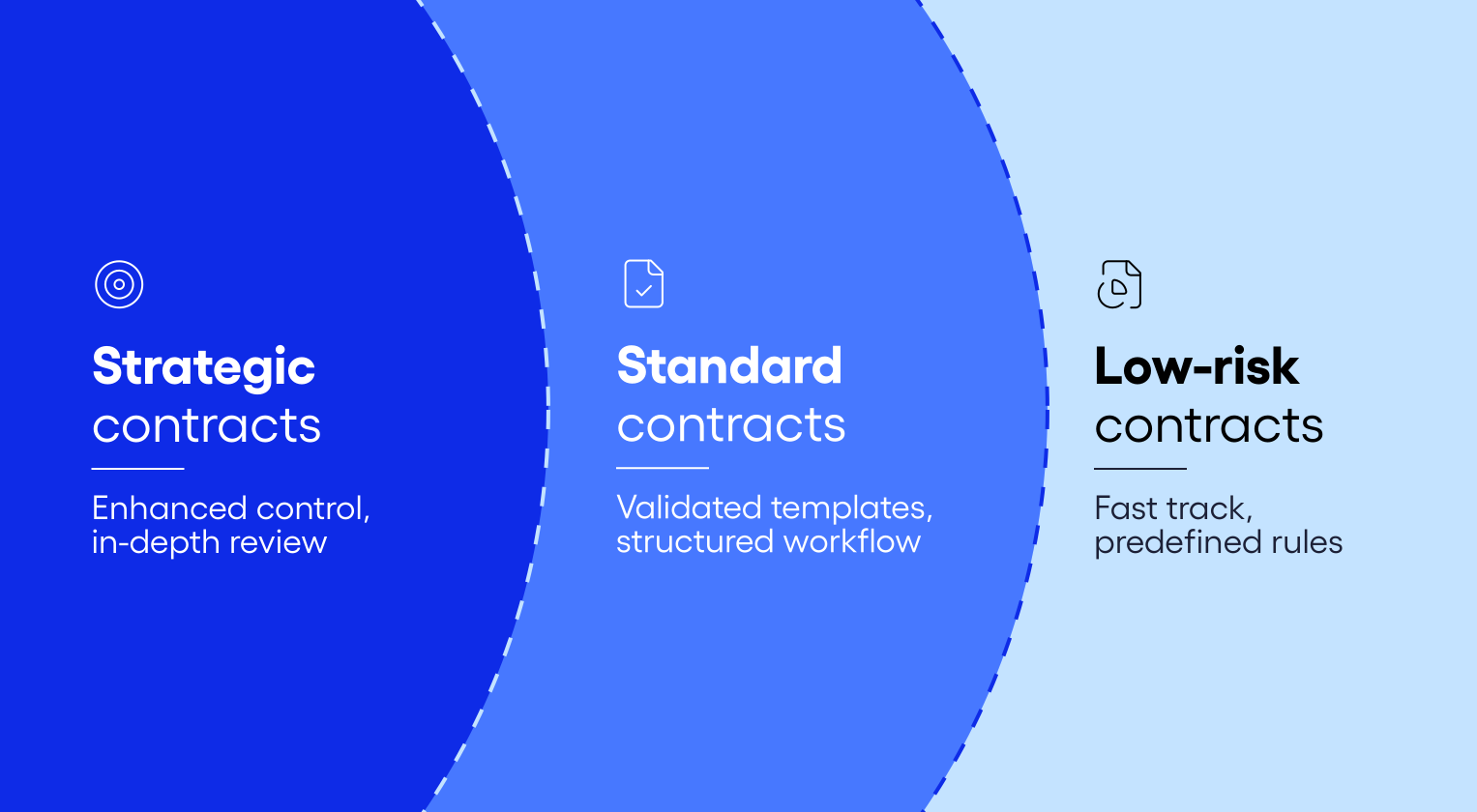
At scale, the effectiveness of contract management relies less on uniformity than on the ability to apply the right level of control to the right contract.
In certain contexts, particularly when the provider is identified but outside the panel, umbrella contracting makes it possible to secure and accelerate contracting within a controlled framework. Used as a full-fledged contract management mechanism, it avoids the multiplication of exceptions while preserving traceability and compliance of commitments. You can consult our umbrella contracting guide to learn more.
At scale, attempting to secure all contracts in the same way is often the primary risk factor.
Organizations that scale are those that:
clearly distinguish strategic, standard, and low-risk contracts,
define simple, understandable, and truly adopted rules,
accept that compliance relies more on the framework than on systematic review.
Rethinking contract management for large organizations
At scale, contract management does not fail due to lack of control, but due to excess uniformity. Attempting to secure all contracts in the same way means applying a rigid framework to deeply heterogeneous uses.
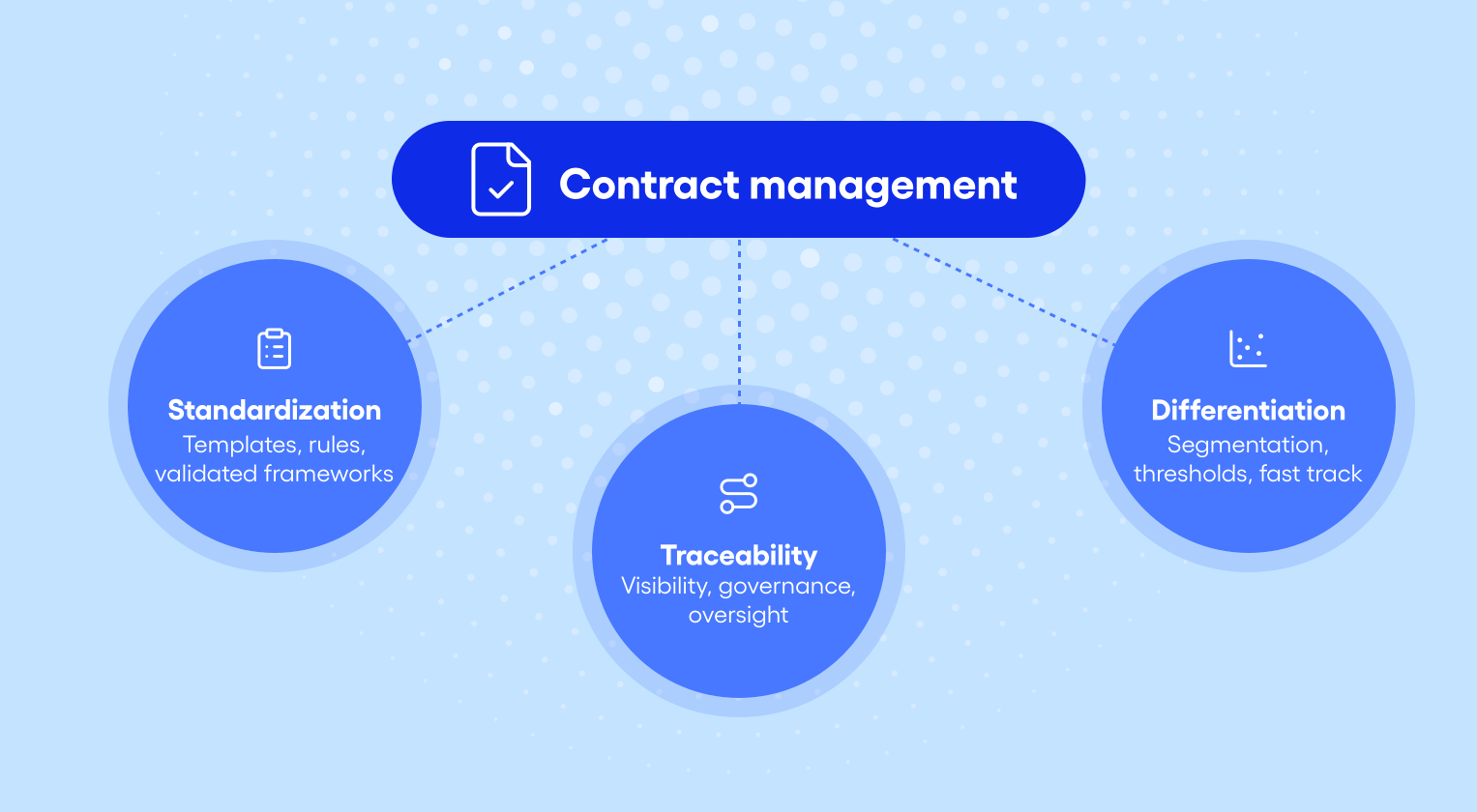
The most high-performing organizations do not seek to contract faster at any cost. They design contractual frameworks capable of absorbing volume, differentiating risks, and enabling execution without bypassing processes. Under these conditions, contract management ceases to be an operational constraint and becomes a true performance lever.
Are you questioning the place of commercial intermediation within your contract management framework, or how to integrate it without creating additional complexity?
These topics are now part of the reflections led by many procurement and legal departments confronted with large-scale contracting.