In large organizations, a growing share of external spend takes the form of ad hoc, low-value needs, often outside the vendor panel and spread across many providers. This is what is commonly referred to as tail spend.
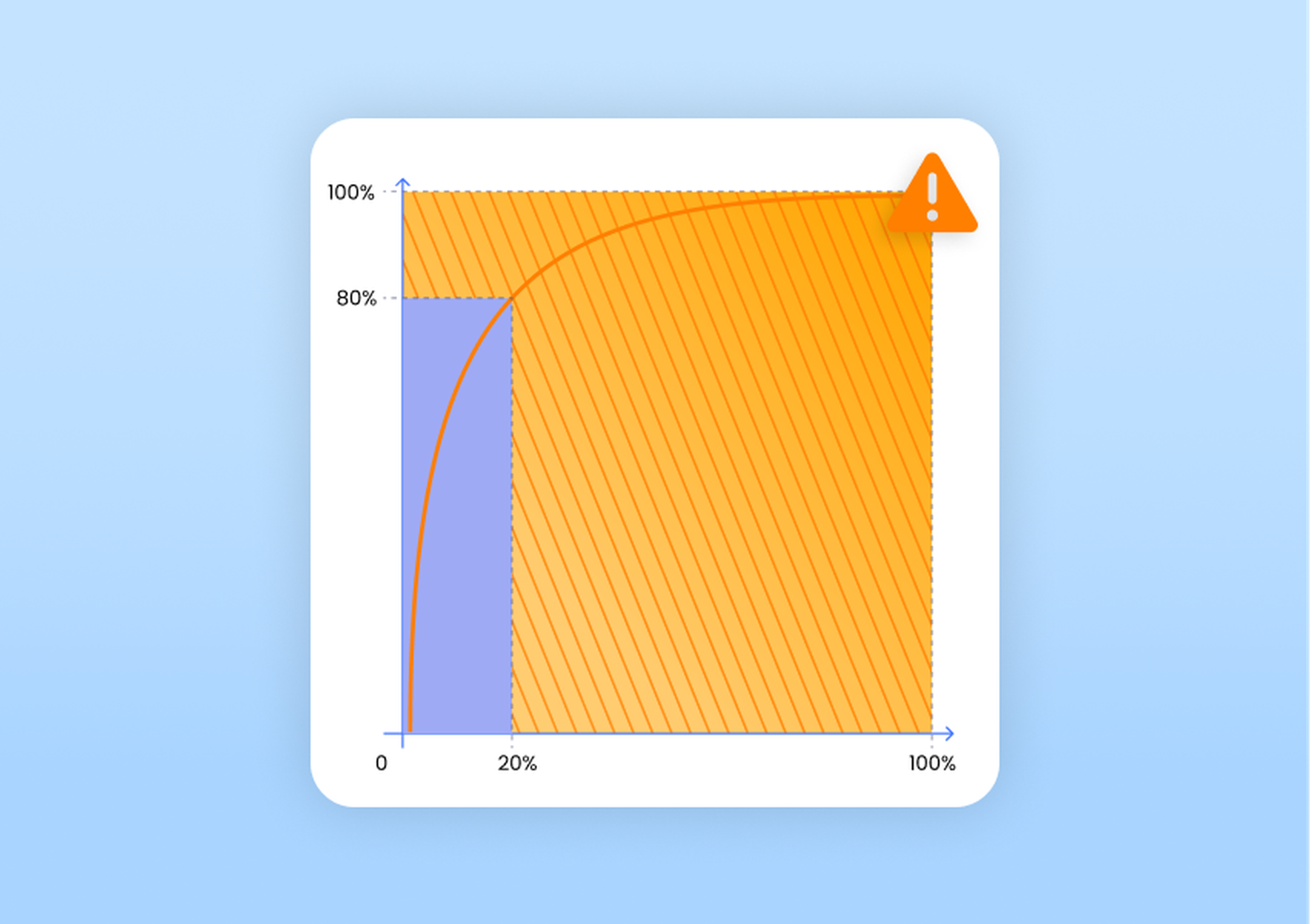
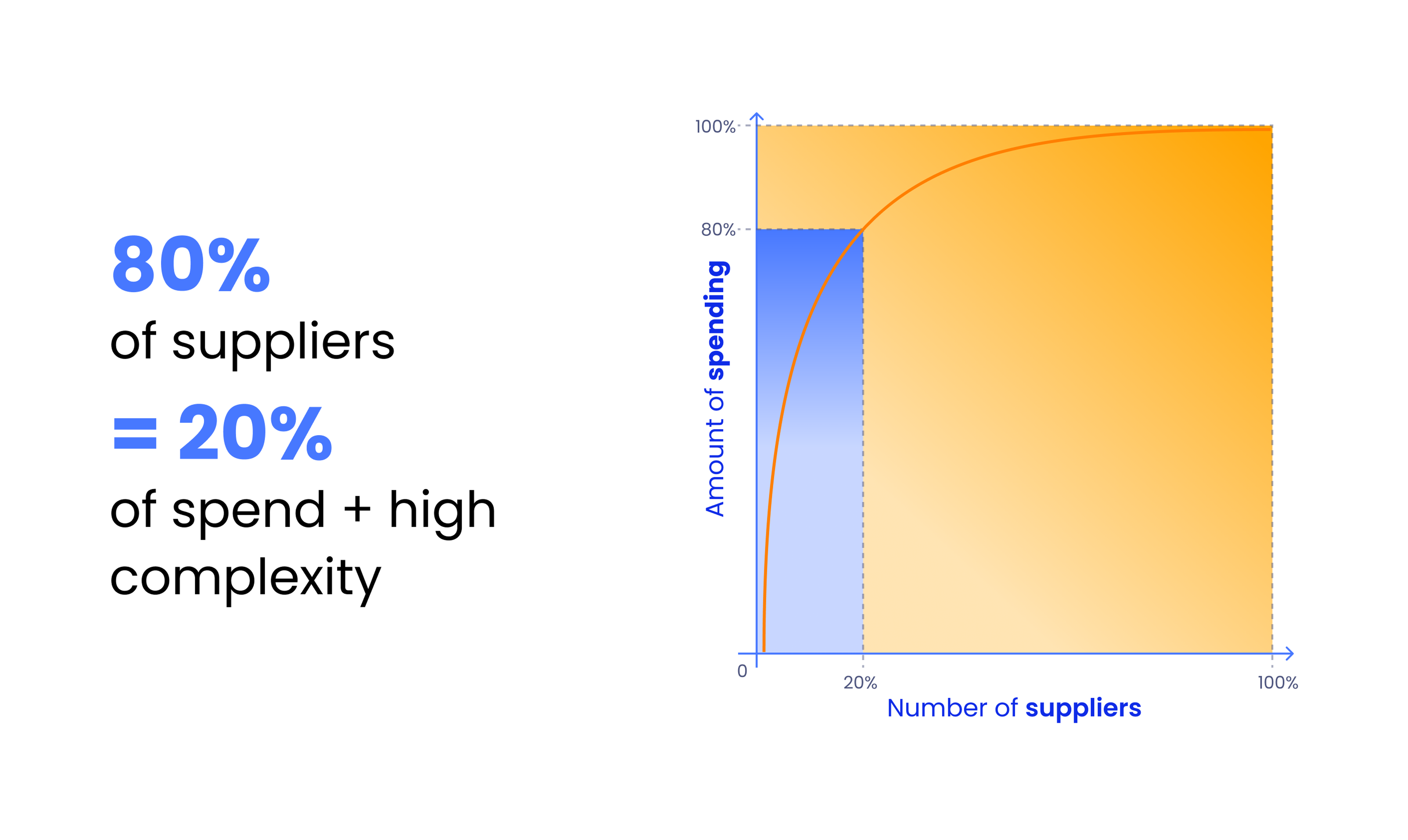
By nature, these expenses are difficult to manage: individually small, but collectively complex. In many cases, they account for a limited share of the overall budget, often between 5% and 20%, yet up to 80% of active suppliers, creating an operational burden and a level of fragmentation that are difficult to control.
This imbalance puts tail spend management at the heart of procurement leaders’ concerns. The issue is not only financial. It is structural: how can organizations effectively manage a high volume of fragmented needs without slowing down business execution?
The challenge of tail spend management is therefore not to centralize everything or multiply controls. It is to define a framework that provides visibility, compliance, and consistency, while preserving the speed and flexibility operations require.
Why tail spend management has become a critical issue for procurement teams
The problem with tail spend is not its size, but its incompatibility with traditional procurement models.
Applying processes designed for strategic suppliers to a multitude of ad hoc needs mechanically creates bottlenecks.
In the professional services market, the number of external experts, freelancers, and specialized consulting firms has grown significantly. At the same time, business needs are multiplying across increasingly specific areas of expertise.
In this context, companies must work with a much broader and more complex skills ecosystem. Expertise is more abundant, more specialized, and often carried out by smaller players that are less represented in traditional procurement frameworks.
At the same time, most organizations still rely on restricted supplier panels and on processes designed for a limited number of partners, approvals, and contracts. This model, historically suited to concentrated and structured spending, is now showing its limits in the face of growing volume and increasingly diverse needs.
As a result, these frameworks only provide access to a fraction of the available market. In some cases, companies tap into less than 1% of accessible expertise, even as they seek greater flexibility and struggle to secure certain critical skills.
This gap creates growing tension between business expectations and procurement’s actual capacity to respond. On one side, needs are becoming more frequent, more urgent, and more specific. On the other hand, management models remain designed for a more stable environment, with fewer suppliers and fewer cases to process.
It is precisely this change of scale that makes tail spend management more difficult. What is changing is not only the nature of the spend itself, but also the volume, frequency, and diversity of the situations that need to be handled.
 What does tail spend management look like in practice?
Tail spend generally refers to low-value spend that is high in volume, fragmented, and often poorly structured. It typically involves less frequently used suppliers, one-off purchases, short assignments, or decentralized needs. It can also be described as Class C spend, following a Pareto-type logic, with a small share of total spend but a large share of sub-categories.
In professional services, this may include:
an expert identified by a business team for a one-off assignment,
a niche capability missing from the existing vendor panel,
a specialized consulting firm engaged on a limited scope,
an urgent need that does not justify a lengthy vendor onboarding process,
a short project whose face value is low, but whose operational importance is high.
Tail spend management is about bringing structure to this often poorly organized area. It means making this spend visible, limiting unnecessary fragmentation where relevant, and designing processes that fit its nature. It also means accelerating the handling of simple cases, securing contracts, and preventing business teams from bypassing existing processes when those processes are too constraining.
The goal is not only to optimize costs, but to increase the share of spend genuinely managed by procurement, by turning a fragmented and opaque area into something coherent, traceable, and governable.
Definition – Tail spend
Tail spend refers to low-value spend, generally spread across a large number of suppliers and often only partially covered by standard procurement processes.
Why is tail spend difficult to manage?
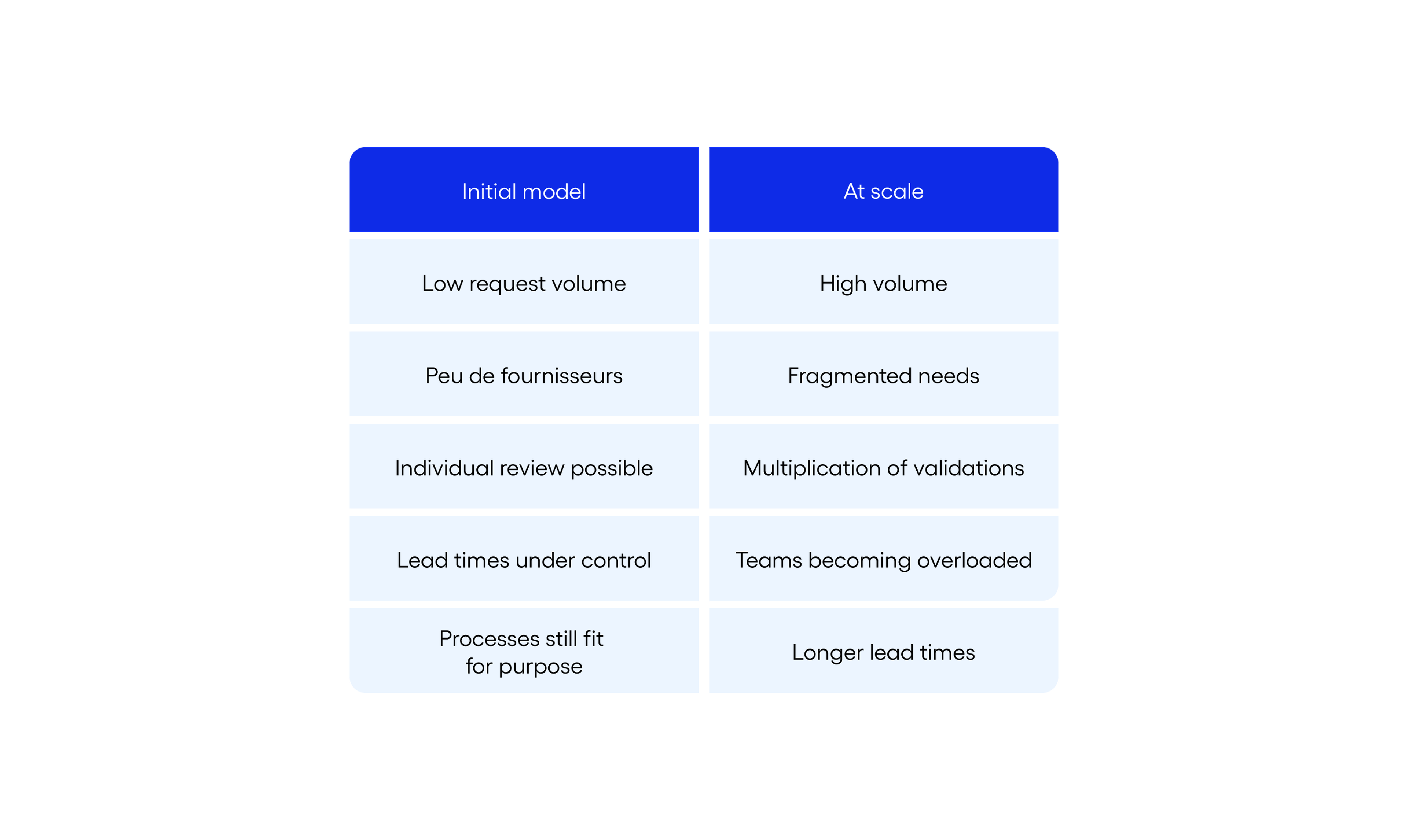
Tail spend management is complex because it relies on several structural factors: a high volume of requests, strong fragmentation of needs, supplier multiplication, and limited process standardization.
Taken individually, these factors are manageable. But at scale, their combination creates an operational burden that is difficult to absorb and complicates visibility, control, and compliance at the same time.
Why traditional procurement models fail in tail spend management
The first issue in tail spend management is not a lack of tools. It is a mismatch between the nature of the needs and the management model being applied.
Organizations have historically structured procurement around a limited number of approved suppliers, relatively significant contracts, and demanding processes justified by negotiation, compliance, and risk control requirements. This model remains relevant for strategic spending, where each engagement justifies a deeper level of review.
It becomes far less effective, however, when it is applied indiscriminately to a multitude of ad hoc needs, often low in value but high in frequency. The problem is not the risk level itself, but the volume and repetition of cases that need to be processed.
Onboarding a supplier entails a real cost in time, coordination, and administrative workload. In professional services procurement, that cost is far from negligible, which explains why supplier panels are often deliberately kept limited.
This logic makes sense at an individual level, but becomes counterproductive at scale, when needs increasingly arise outside the existing panel.
That is when the limits of the model become clearly visible.
When volume becomes the problem
As request volume grows, simple situations start following the same paths as more sensitive cases. Processing times lengthen because each request triggers similar validation and control steps. Faced with operational pressure, business teams then multiply urgent requests in order to bypass those delays. At the same time, procurement and legal teams devote a growing share of their time to repetitive cases with limited added value.
The breaking point therefore does not come from too much risk, but from too much uniformity in how requests are handled.
At that stage, the issue is no longer simply about optimizing tail spend management.
It becomes necessary to rethink how it is structured and managed at scale.
At scale, the accumulation of micro-decisions, approvals, and identical controls creates structural friction. Processes designed to secure operations then become sources of delay, or even of circumvention.
 Maverick spend: a symptom of the limits of tail spend management
Maverick spend appears when the cost of using the procurement process becomes higher than the cost of bypassing it.
At that point, the problem is no longer behavioral, but structural: the operating model is no longer suited to the scale or nature of the needs.
In many organizations, maverick spend is still approached as a discipline issue: business teams are seen as not respecting the rules, bypassing procurement, or taking initiatives outside the approved framework.
That reading is incomplete.
Some situations do indeed stem from non-compliance with the rules. But in most cases, maverick spend does not emerge in isolation. It develops when existing processes can no longer respond effectively to operational needs.
When a business need requires a specific expertise within a short timeframe, teams do not bypass procurement on principle. They are trying to execute. Likewise, when a relevant supplier has been identified but contracting would require a long and complex process, bypassing the formal route becomes a pragmatic option rather than an exception.
Maverick spend then becomes the result of a misalignment between governance and execution.
A self-reinforcing mechanism
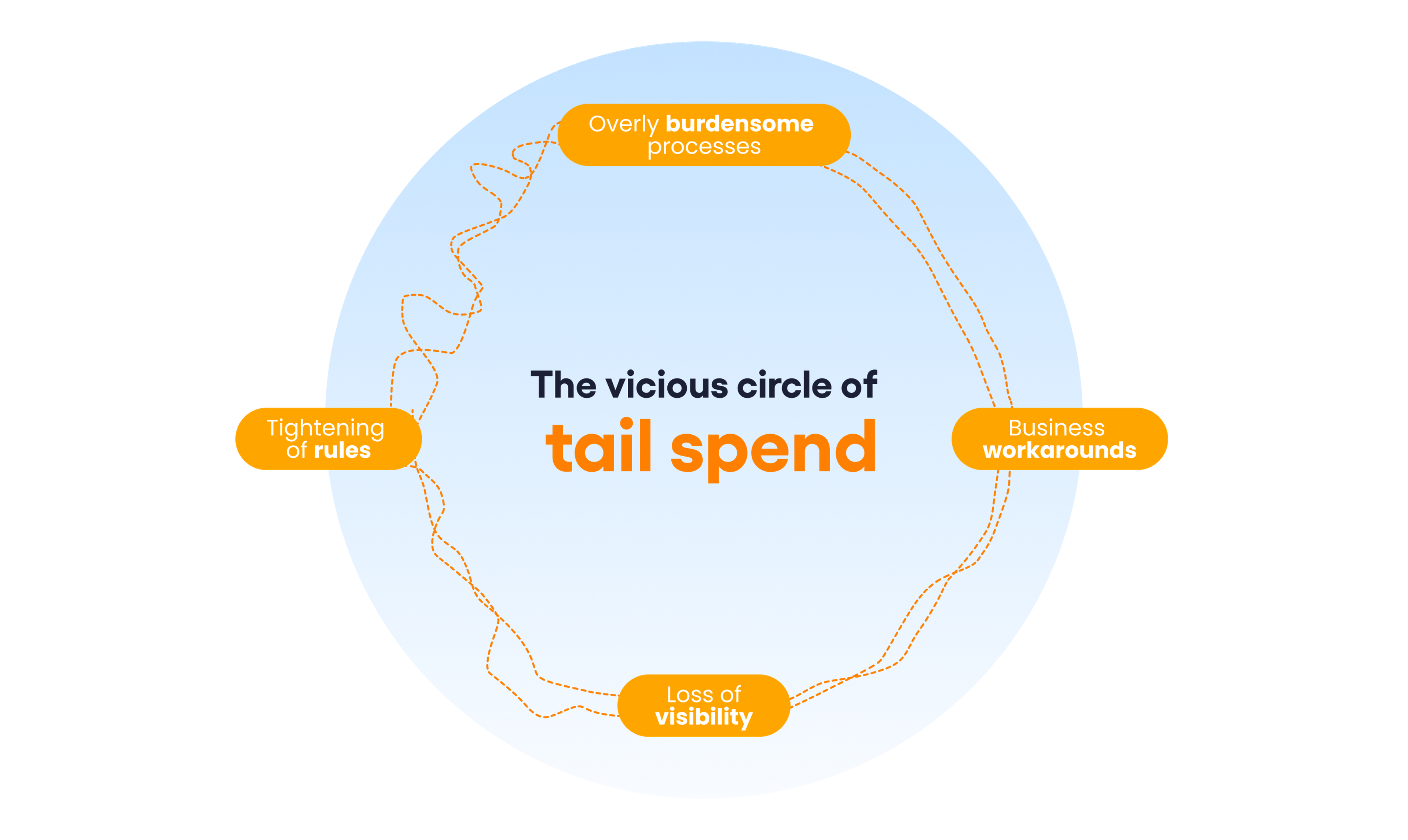
As this gap widens, behaviors evolve. Business teams multiply urgent requests or develop alternative routes to secure their projects. In response, the organization reinforces controls to reduce deviations. But these additional controls increase friction, lengthen delays, and make processes even less adapted to real needs.
A cumulative mechanism then sets in: the more rigid the framework becomes, the more exceptions develop; the more exceptions develop, the more theoretical control becomes.
Maverick spend is therefore not just a compliance issue. Above all, it reveals the limits of a model that can no longer absorb the diversity, frequency, and speed of business needs.
This issue goes far beyond simple rule enforcement. It concerns process design, the way procurement interacts with the business, and the organization’s ability to create simple routes for simple cases, while maintaining a robust framework for more sensitive situations.
 Why the real challenge is balancing control and agility
Tail spend management is often presented as a trade-off between two incompatible objectives:
Control: compliance, traceability, visibility, cost control, contractual security.
Agility: speed of execution, access to expertise, ease of use, ability to respond to urgency.
In practice, large organizations cannot prioritize one at the expense of the other. They need to be able to guarantee a secure framework while enabling fast execution.
This tension has intensified with market evolution. The increase in the number of providers, the specialization of expertise, and the multiplication of ad hoc needs force companies to collaborate with a broader and more heterogeneous ecosystem. In that context, relying only on centralized control mechanisms becomes insufficient, while an overly open model leads to a loss of visibility and control.
A false opposition
The problem, then, does not lie in the existence of this tension, but in the way it is handled.
Trying to secure operations by adding validation steps slows execution. Conversely, accelerating without a clear framework weakens compliance and traceability.
The real issue lies elsewhere: designing workflows that embed control from the outset.
In other words, the objective is no longer to stack validation layers on every request, but to define rules, models, and processes adapted to different levels of risk. In that kind of setup, simple cases can be processed quickly within a secure framework, while more sensitive situations continue to benefit from stronger control.
That is the logic that makes it possible to move from control through accumulated approvals to control by design.
What does an effective tail spend management model look like?
An effective tail spend management model does not rely on tighter controls, but on adapting the operating model to different types of needs. This kind of model is built on a simple principle: treating different kinds of needs differently.
In practical terms, that means moving away from a uniform logic and adopting a segmented approach:
simplified workflows for recurring, low-risk needs, in order to reduce delays and operational workload,
a structured framework for off-panel providers, making it possible to secure collaboration without overburdening processes,
broader access to the supplier market, enabling faster mobilization of specific expertise that is not available in the existing panel,
standardized and scalable contracting, capable of absorbing a high volume of requests without creating friction.
The goal is not just to optimize costs, but to increase the share of spend that is genuinely managed by procurement by turning a fragmented and hard-to-read area into a coherent, traceable, and governable whole.
This management approach is directly linked to the concept of spend under management, which we explore in more detail in this article: Tail spend management: how to effectively increase spend under management.
From a panel logic to a more open tail spend management model
For a long time, the supplier panel was the main tool used by procurement teams to structure the supplier market. It helped secure relationships, standardize practices, and concentrate volumes on a limited number of partners. This model remains relevant for strategic suppliers, recurring volumes, and long-term relationships.
A new approach to the supplier market
However, it shows its limits as needs become more fragmented and the number of potential providers grows. By definition, a panel relies on a logic of selection and stabilization. It is therefore not designed to absorb a continuous flow of new needs, nor to integrate niche or ad hoc expertise quickly.
It is in this context that marketplaces are increasingly emerging as an operational complement to the traditional supplier panel. They make it possible to broaden access to the supplier market by enabling organizations to mobilize types of expertise that are less represented in traditional frameworks, without bearing the fixed costs associated with one-by-one supplier onboarding.
The point is not to oppose panel logic and openness, but to articulate them.
The panel retains its structuring role for strategic suppliers, while a more open mechanism makes it possible to handle ad hoc needs, rare expertise, short assignments, and off-panel providers more efficiently.
This shift in logic is essential, because it better aligns the procurement model with market reality. Rather than forcing every need into a single framework, the organization adapts its mechanisms to different types of spending.
The result is a move away from a centralized and often rigid control model toward a more open, but still governed, model of market access, with rules, tools, and workflows adapted to the situation. It is this ability to combine openness and control that makes it possible to absorb tail spend more effectively without losing visibility or command.
The role of marketplaces in tail spend management
In a modern approach to tail spend management, marketplaces provide a practical answer to several limitations of the traditional model.
They broaden access to the market by helping identify expertise that is underrepresented in existing supplier panels, without multiplying the costs linked to one-by-one supplier onboarding.
They also help reduce the time required to access capabilities, by structuring sourcing and facilitating the match between needs and profiles.
Finally, they can serve as an intermediate governance layer, organizing access to off-panel providers in an environment that is more readable, traceable, and consistent.
The point is not to replace the existing model, but to handle more effectively the situations it struggles with, especially ad hoc needs, rare expertise, or short assignments.
Contracting at scale: the often underestimated link
Talking about tail spend without talking about contracting means addressing only part of the problem.
In many organizations, the main friction point does not lie in identifying the provider. It lies in the ability to contract quickly, correctly, and repeatedly.
The operational friction point
At scale, contracting becomes a challenge in its own right. Providers are more numerous, needs are shorter, use cases are more heterogeneous, and compliance requirements are higher. In that context, trying to treat every contract as if it were a near-strategic case mechanically creates queues, urgencies, and eventually exceptions.
Time to contract then becomes a key indicator of operational performance. When it increases, projects do not even start on time. Business teams become discouraged. Procurement and legal teams are drawn into repetitive issues. And the organization ends up creating parallel routes.
In this type of situation, some organizations evolve their model to better handle cases where the provider has been identified but cannot be integrated into the supplier panel quickly enough. Umbrella contracting fits within that logic. When embedded in a clear framework, it makes it possible to secure the contractual relationship while reducing implementation timelines, without creating a new layer of exception. To explore this topic more in depth, consult our dedicated guide.
Rethinking tail spend management for large organizations
At scale, tail spend management does not fail because of a lack of control, but because of excessive uniformity.
Applying the same rules to all spend creates friction, slows execution, and encourages circumvention. At scale, that approach becomes counterproductive.
The most effective organizations do not try to eliminate tail spend. They try to structure it so it becomes governable.
That requires accepting a more open market, more fragmented needs, and designing a framework capable of absorbing that complexity without multiplying exceptions.
That is the condition under which tail spend becomes a performance lever rather than a source of lost control.
These issues are now part of the reflections being carried out by many procurement leaders facing tail spend management at scale and the need to reconcile market openness with operational control.