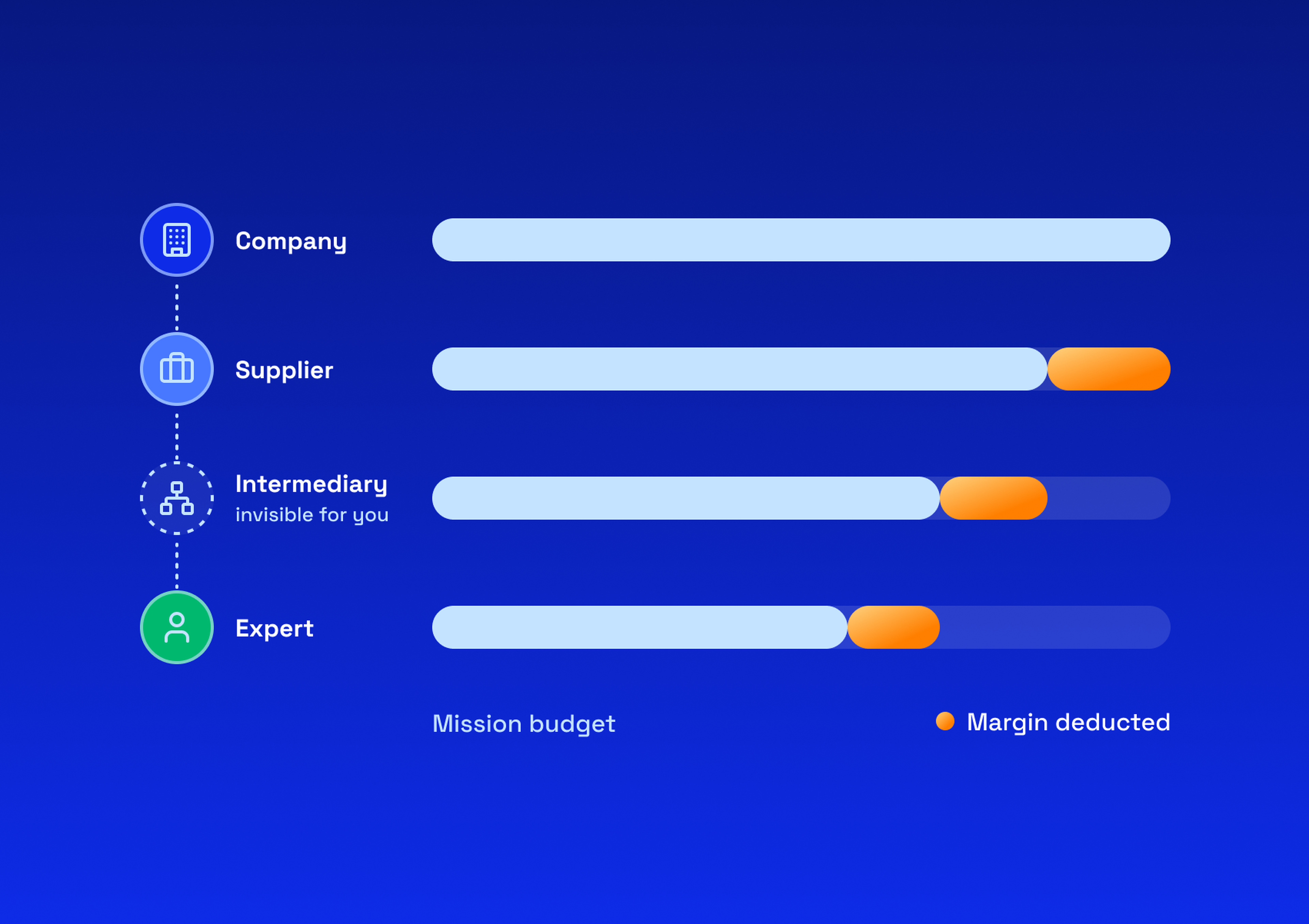
A project may look controlled on paper while several intermediaries stand between the client and the expert doing the work. A subcontracting chain affects price, visibility, accountability and sometimes delivery quality. For Procurement, the issue is not only the daily rate. It is the full cost and the ability to explain who is involved.
Direct answer
A subcontracting chain can increase the full cost of an assignment when several intermediaries add fees, margins, coordination time and replacement risk. To measure the impact, compare the client price, the cost of the expert actually doing the work and the internal cost of control.
What a subcontracting chain means
Subcontracting occurs when a supplier entrusts all or part of a service to another provider. When that second provider uses another subcontractor, the chain becomes layered. The French Subcontracting Act of 31 December 1975, in the current version consulted in 2026, defines the operation as the execution of part of a contract by a third party under the main contractor’s responsibility.
A chain is not automatically unlawful. It must be compatible with the contract and managed through clear responsibilities and the applicable disclosure rules. Article 3 of the French Act requires, within its scope, the acceptance of each subcontractor and approval of payment terms by the project owner. For public contracts, the French Legal Affairs Directorate explains the disclosure, acceptance and control rules, including situations with several subcontracting levels.
Why the cost increases
The cost of a chain is not limited to the visible margin of each intermediary. It can also include coordination time, document checks, contract administration, replacement costs, approval delays and rework. The longer the chain, the harder it becomes to connect the price paid with the value delivered.
Consider an illustrative example. A 100 day assignment is billed at 900 euros per day, or 90,000 euros before tax. In a direct sourcing scenario, the expert cost is assumed for illustration at 700 euros per day, or 70,000 euros. With two intermediaries applying illustrative markups of 8 % and then 7 %, the reconstructed cost reaches 80,892 euros before coordination costs. The 10,892 euro gap is not automatically net margin. It may fund sourcing, delivery management, commercial risk or overhead. It should nevertheless be explainable.
If internal coordination adds an illustrative 4,000 euros, the full cost reaches 84,892 euros. The difference with the client price is then 5,108 euros. This example is a method for reading the economics of a chain, not a market average.
What public figures can measure
Public sources do not provide a universal percentage for the extra cost of layered subcontracting. They do provide compliance thresholds.
In the scenario currently built into the LittleBig Connection calculator, subcontracting chains affect 15 % of assignments and each level adds a 20 % markup. These values create a consistent estimate. They should not be presented as universal statistics applying to every company. The French Labour Ministry states that vigilance checks are mandatory for operations of at least 5,000 euros before tax. They must be performed when the contract is signed and renewed every six months during execution, under the applicable rules.
Article D8222-5 of the French Labour Code lists the documents used in these checks. The question is therefore not only how many intermediaries are involved. It is also which entity carries the contractual relationship, which documents have been checked and who is accountable for the expert actually assigned.
The cost items to include
Procurement can separate four categories. Delivery cost is the price or rate of the expert actually doing the work. Intermediation cost includes documented margins, commissions or service fees. Control cost includes time spent by Procurement, business teams, Legal, Finance and Security. Risk cost includes measurable delays, replacement, rework, access incidents and compliance remediation.
This separation prevents every gap between the client price and the expert rate from being labelled hidden margin. It also enables a fair comparison with direct sourcing, a freelancer, a consulting firm or a specialist provider.
Want to estimate the impact of intermediary layers in your organisation? Use the Sourcing and Umbrella Contracting Cost Savings Calculator with your own volumes and current rates.
How to reduce chains without slowing delivery
Start with transparency. The contract should identify subcontractors, require approval for material changes and define responsibility for delivery, security and replacement. Then reconcile the assignment, contract, invoice and actual profile. Finally, track the average number of levels, the share of assignments with undeclared participants, the time needed to approve a change and the difference between invoiced price and reconstructed cost when data is available.
Conclusion
A subcontracting chain can provide capacity or specialist expertise, but it becomes expensive when the client loses visibility over participants, responsibility and pricing. Full cost analysis based on verifiable documents helps Procurement decide whether to keep, renegotiate or simplify the chain.
Want to estimate your potential savings on sourcing and umbrella contracting? Use the Sourcing and Umbrella Contracting Cost Savings Calculator.
The legal sources cited here are French and apply to France specific operations. Subcontracting disclosure, vigilance and payment rules vary by country. Local Legal and Procurement teams should validate the applicable framework before using this guidance for an international assignment.
Public sources
French Subcontracting Act of 31 December 1975, current version consulted in 2026, Légifrance.
French Legal Affairs Directorate, 2026, Subcontracting.
French Labour Ministry, 2026, Principal or client responsibility.
French Labour Code, Article D8222-5, current version consulted in 2026, Légifrance.