The titles data engineer and DataOps engineer often appear in the same job posting, sometimes in the same sentence. The two functions complement each other, but they answer different questions. Conflating them produces a team that builds fast and operates badly.
What data engineering does
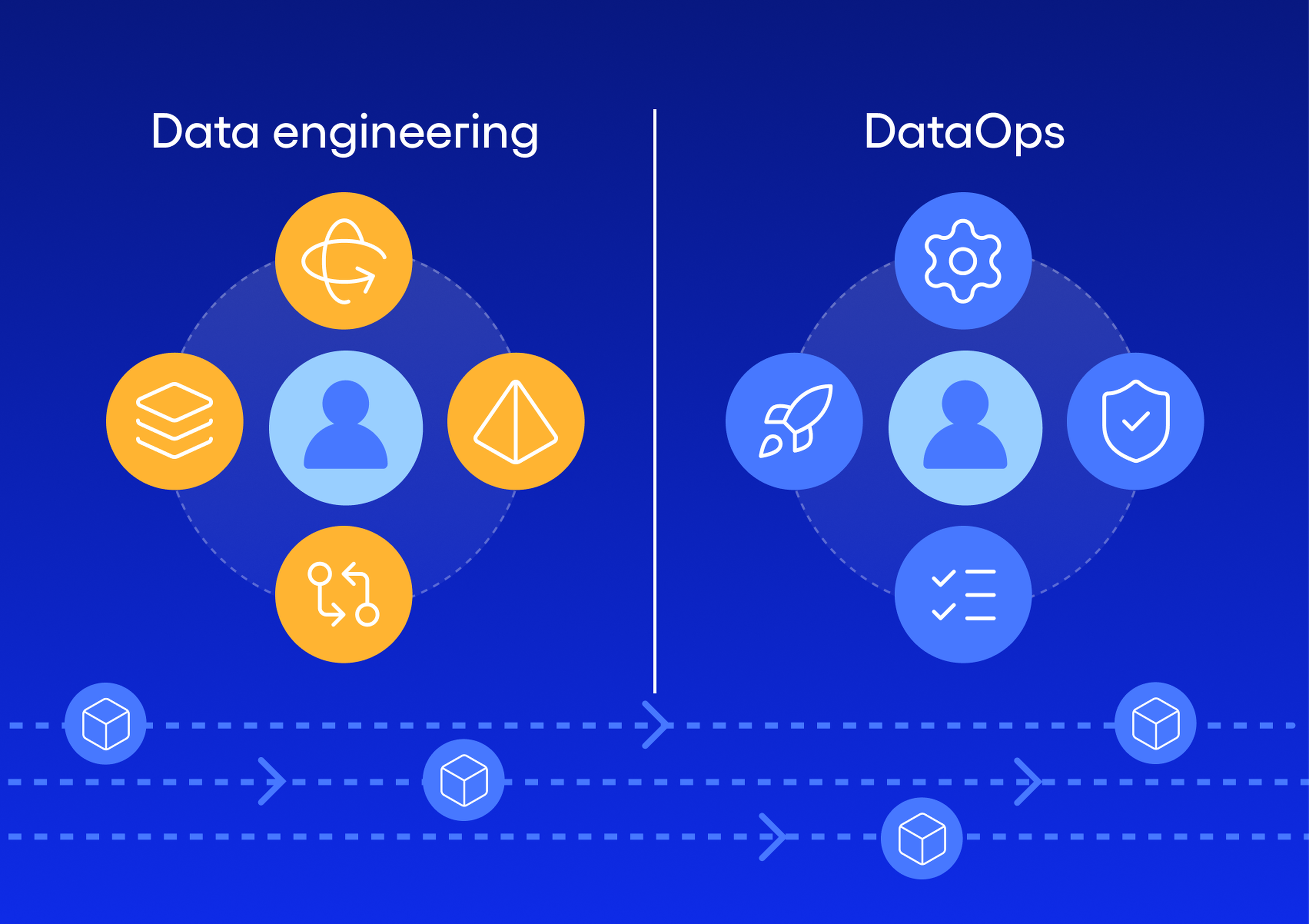
Data engineering builds the pipelines that make data usable: ingestion, transformation, modelling, performance, history.
The data engineer designs pipelines, chooses data models, optimizes processing and maintains consistency across sources. That work determines what the platform is capable of producing.
In practice, four decisions are structural: the granularity of retained data, the history strategy, how schema changes are handled, and how transformations are split into reusable layers. Those choices commit the platform for years.
What DataOps does
DataOps applies DevOps practices to data pipelines: testing, automation, deployment, observability, incident handling.
The DataOps profile works on reliability, repeatability and speed of correction. It installs data tests, alerts, recovery procedures and operating routines.
dbt Labs documentation on data testing illustrates the logic well: express verifiable assertions about data so anomalies are caught before they reach users. That is not a build practice, it is an operating practice.
Key takeaways
-Data engineering produces capability; DataOps produces reliability.
-Modelling decisions commit the platform for years; operating decisions are corrected in weeks. -A team without DataOps only finds anomalies when a user reports them.
Comparing the two functions
| Criterion | Data engineering | DataOps |
|---|---|---|
Objective | Make data available and usable | Make pipelines reliable and predictable |
Core question | What should the platform produce? | How do we guarantee it produces it every day? |
Key activities | Pipelines, transformations, modelling, performance | Testing, CI/CD, observability, incidents, quality |
Deliverables | Data models, jobs, technical documentation | Test suites, alerts, runbooks, operating dashboards |
Horizon | Structural, multi-year | Operational, daily |
Symptom when missing | Missing, inconsistent or slow data | Anomalies reported by users, recurring incidents |
One person can hold both roles in a small team. Separating them becomes necessary once the number of pipelines, sources or consumers makes manual tracking impossible.
How responsibilities divide
The clearest boundary is not the tooling. It is the question each role answers.
The data engineer answers “what should the platform produce”. The DataOps profile answers “how do we guarantee it produces it every day, and how do we fix it fast when it stops”.
In a mature organization, the two meet on three shared objects:
1. Data contracts between producers and consumers, defining schema, freshness and expected quality
2. Tests, written by the engineer who knows the data and industrialized by the DataOps profile
3. Operating indicators, readable by both and by business users
How to hire or source the right profile
Describe the symptoms before describing the role. The need differs depending on what the team is living through.
You need a data engineer if: data is missing, models do not answer business questions, processing is too slow, sources contradict each other, or every new request requires bespoke development.
You need a DataOps profile if: incidents recur, anomalies are reported by users rather than detected by the platform, deployments are manual and risky, or nobody can say whether last night’s pipeline ran.
In an RFP or a job description, state the tooling in place, the number of pipelines and sources, freshness requirements and the expected service level. A candidate cannot position themselves usefully without those.
Mistakes to avoid
Hiring a data engineer to solve an operating problem. An excellent engineer will spend the year firefighting instead of building, and the team will wrongly conclude it needs another engineer of the same kind.
Installing DataOps without data owners. Tests imply rules; rules imply someone who arbitrates them.
Treating DataOps as a tool to buy. Tooling replaces neither tests written by people who know the data, nor incident procedures.
Separating the two functions too early. In a small team, separation creates handoffs more costly than combining the roles.
Key takeaways
-Describe symptoms before the role: they identify the profile unambiguously.
-Three shared objects underpin the collaboration: data contracts, tests, operating indicators.
-Separating the two roles too early costs more than combining them.
Conclusion
Data engineering and DataOps answer two complementary questions: what the platform should produce, and how to guarantee it produces it reliably. An organization that does not distinguish them ends up sacrificing the second.
Describe your symptoms, identify the missing function, then source accordingly.