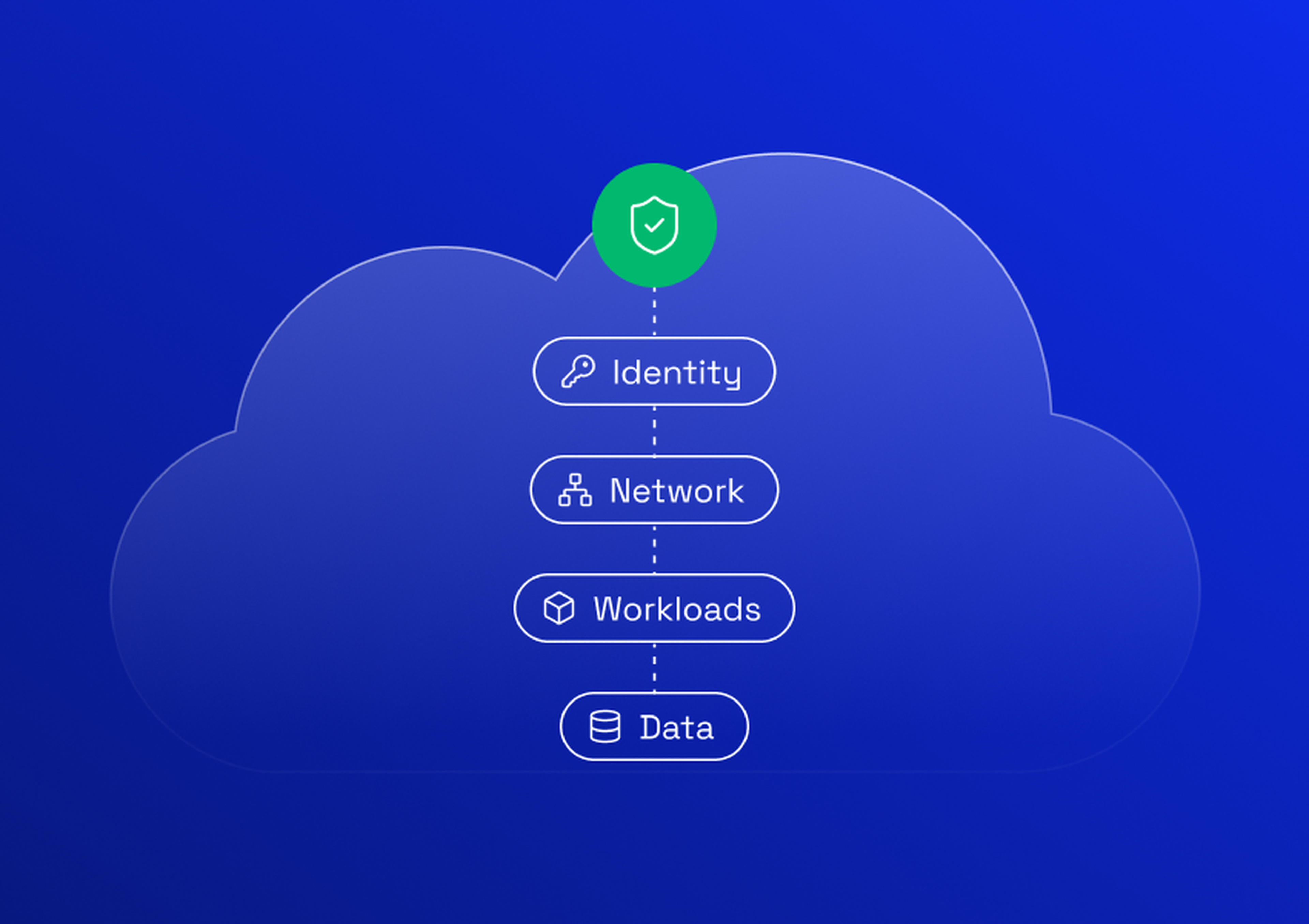
Most cloud incidents do not come from a provider vulnerability. They come from a configuration, an over-permissive identity or an exposed storage bucket. In other words, from the customer side of the shared responsibility model.
Securing a cloud environment requires specific skills: identity and access management, configuration, isolation, monitoring, compliance and automation.
What cloud security covers
Cloud security combines several domains, none of which is sufficient alone.
• Identity and access: authentication, authorization, privileged accounts, secret rotation
• Configuration: service hardening, drift detection, automated correction
• Network and isolation: segmentation, exposure, filtering, egress points
• Data: encryption, classification, location, retention periods
• Monitoring: logging, correlation, detection, response
• Compliance: applicable requirements, evidence, periodic reviews
• Automation: infrastructure as code, controls embedded in the deployment chain
Cloud providers publish a shared responsibility model that splits obligations between provider and customer. A significant share always stays with the customer, and it is precisely the share teams underestimate.
The shared responsibility model in practice
| Domain | Usually the provider | Usually the customer |
|---|---|---|
Physical infrastructure | Yes | No |
Hypervisor and managed services | Yes | No |
Service configuration | No | Yes |
Identities, permissions, secrets | No | Yes |
Data and application encryption | Shared | Yes for classification and keys, depending on the option chosen |
Logging and detection | Log provision | Enablement, retention, exploitation |
Compliance | Platform certifications | Compliance of usage |
Check this split in your provider’s contractual documentation: it varies by service consumed, particularly between infrastructure, platform and managed software.
Key takeaways
-Most cloud risk sits on the customer side: configuration, identities, exposure.
-The split of responsibilities varies by service type, not only by provider.
-Enabling a log is not enough: it has to be retained and exploited.
The profiles to mobilize
| Profile | Contribution |
|---|---|
Cloud security engineer | Secure configuration, automated controls, drift correction |
Cloud security architect | Isolation, exposure, encryption, structural choices |
IAM specialist | Permission model, privileged accounts, federation, secrets |
SOC or detection analyst | Logging, detection rules, alert response |
Compliance expert | Applicable obligations, evidence, reviews |
DevSecOps profile | Embedding controls in the deployment chain |
FinOps | Trade-offs between cost, logging and level of control |
The IAM specialist is the most decisive and the scarcest profile. In a cloud environment, the permission model is the main attack surface, and its complexity grows faster than the infrastructure’s.
How to structure the approach
1. Inventory. Accounts, subscriptions, projects, services consumed, environments. An incomplete inventory makes everything downstream approximate.
2. Map sensitive data. Location, classification, retention period, who has access.
3. Audit configuration. Compare the real state against hardening baselines, service by service.
4. Rework the permission model. Reduce standing privileges, extend strong authentication, trace reviews.
5. Enable and exploit logging. Decide what is collected, how long it is retained, and who handles alerts.
6. Automate controls. Embed configuration drift detection in the deployment chain rather than in a quarterly review.
7. Document and have it reviewed. Establish the evidence expected for each measure.
Mistakes to avoid
Assuming the provider secures everything. The platform is certified; the usage is not.
Stacking tools without a permission model. A misconfiguration detection tool reports hundreds of findings. Without prioritization or an owner, the list becomes noise.
Enabling logging without exploiting it. Logs collected and never read create cost and an illusion of control.
Treating multicloud as one cloud. Permission models, services and control mechanisms differ. A team competent on one provider needs ramp-up time on another.
Separating security from deployment. Controls added afterwards get bypassed as soon as the schedule tightens.
Key takeaways
-Start with the inventory: without it, no measure is reliable.
-Reduce standing privileges before buying a detection tool.
-Multicloud multiplies permission models, not just providers.
Conclusion
Securing a cloud environment requires a combination of technical skills, governance and automation. Most of the risk sits on the customer side: configuration, identities, exposure, log exploitation.
Start with the inventory and the permission model. Tools come afterwards, and serve better once they have an owner.