Wrong data costs more than missing data. Missing data blocks a process, which is visible. Wrong data feeds a dashboard, a decision or a model, which is not.
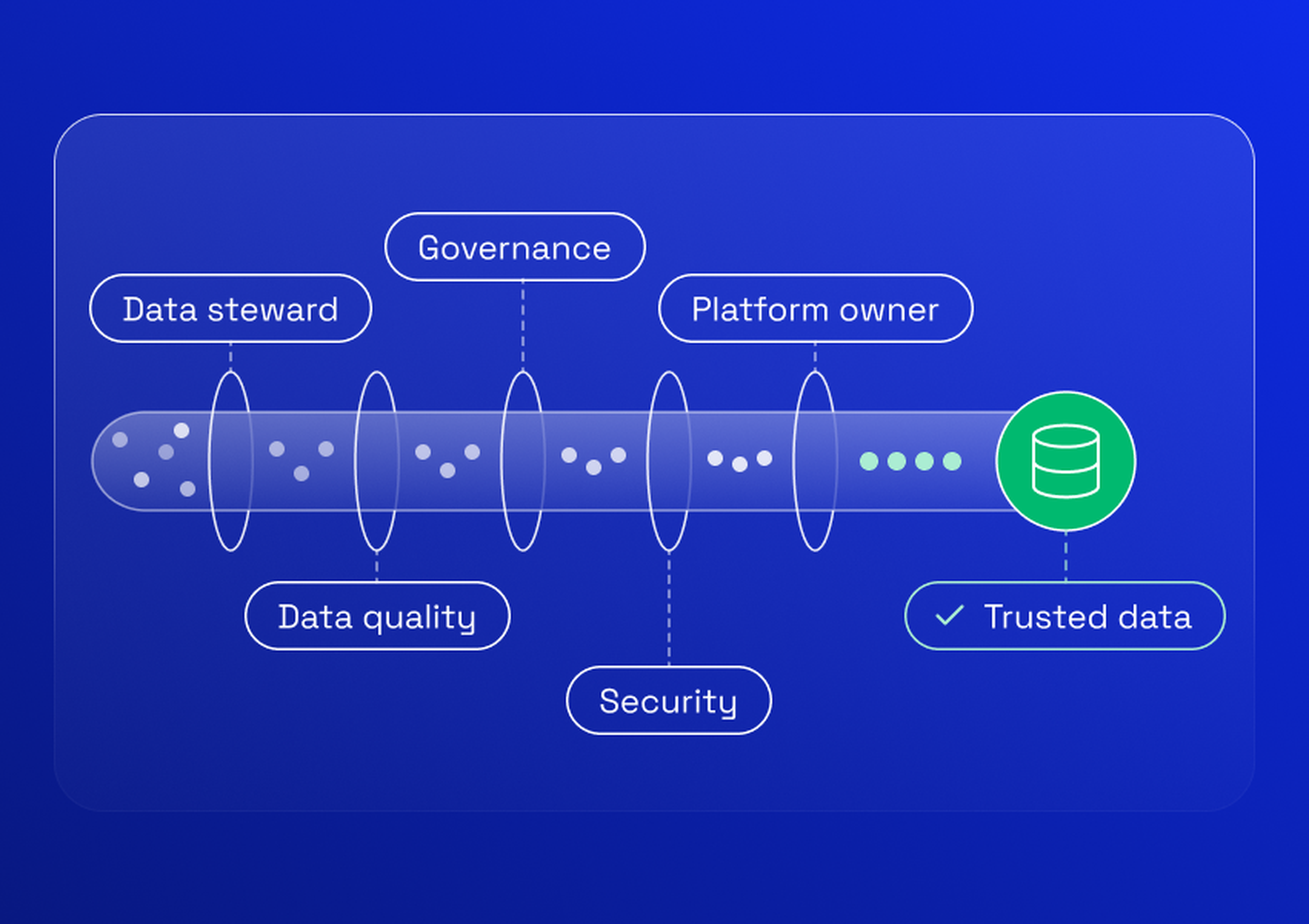
Data quality and governance determine how much confidence sits behind analyses, dashboards and AI models. Both usually fail for the same reason: they are treated as technical projects when what they need first is owners.
What data quality covers
Data quality is measured on observable dimensions rather than on a general impression.
| Dimension | Question asked | Example check |
|---|---|---|
Accuracy | Does the value match reality? | Check against a reference source |
Completeness | Are mandatory fields populated? | Null rate on critical fields |
Consistency | Do sources contradict each other? | Reconciliation between two systems |
Freshness | Is the data current against the commitment? | Gap between expected and actual load time |
Uniqueness | Are there duplicates? | Duplicate key detection |
Traceability | Do we know where the data comes from? | Documented lineage from source to use |
Checks should target the fields that matter, with alert thresholds and a remediation procedure. Measuring quality without defining who fixes it, and within what timeframe, produces a dashboard rather than an improvement.
What data governance covers
Governance defines roles, rules and decisions: who owns a data domain, who authorizes access, how definitions are maintained, which regulatory obligations apply.
A useful reference frame exists. Under the GDPR, a controller has to be able to demonstrate compliance, notably through documentation and a record of processing activities. That evidence requirement is structural: it turns governance from a principle into a documentary obligation.
Key takeaways
-Quality is measured on six observable dimensions, not on an impression.
-A check with no owner and no correction deadline produces no improvement.
-Governance is an evidence obligation as much as an organizational principle.
The roles to mobilize
| Role | Responsibility | Positioning |
|---|---|---|
Data owner | Decides rules, arbitrates use and access on a domain | Business, with decision authority |
Data steward | Applies rules, maintains definitions, tracks quality | Business or cross-functional, daily |
Data quality analyst | Analyzes anomalies, measures, prioritizes remediation | Cross-functional or in the data team |
Data engineer | Implements checks, tests and alerts in the pipelines | Technical |
Head of governance or CDO | Overall framework, cross-domain trade-offs, reporting | Executive |
DPO and legal | Compliance, personal data, retention, records | Dedicated function |
Security | Access, isolation, encryption, traceability | Technical and governance |
The combination depends on organization size, number of domains and regulatory demands. One point is non-negotiable: the data owner has to be a business role with real authority. An owner without arbitration power turns governance into documentation.
How to launch something useful
Initiatives that fail start with an exhaustive catalogue. Those that succeed start with a use case.
Six steps, in order:
1. Choose a priority use case: an executive dashboard, a model in production, a regulatory report
2. Identify that use case’s critical data: rarely more than twenty to thirty fields
3. Name a data owner per domain concerned, by name
4. Define checks and thresholds on those fields only
5. Automate measurement and alerting, with an identified recipient
6. Organize remediation: who fixes, within what deadline, with what audit trail
An external expert can install the checks, structure the catalogue or support the rollout of roles. Data ownership has to stay internal: it is the one element no engagement can supply.
Mistakes to avoid
Starting with the tool. A catalogue or a quality solution creates neither rules nor owners. It makes visible what has been decided, and decides nothing.
Measuring everything. Checks across hundreds of fields produce alert noise nobody processes. Concentrate on fields that carry a decision.
Naming a technical owner. A data owner inside the data team lacks the authority to arbitrate a business use. The role belongs to the business.
Forgetting the correction loop. An anomaly that is detected but not fixed erodes confidence faster than one that goes undetected, because it proves the mechanism achieves nothing.
Key takeaways
-Start from a priority use case, never from an exhaustive catalogue.
-Twenty to thirty critical fields are enough to begin.
-A detected anomaly with no organized correction destroys confidence in the whole mechanism.
Conclusion
Data quality and governance determine confidence in analyses and models. They rest less on tools than on identified owners, arbitrated rules and a correction loop that works.
Start small, on a use case that matters, with named owners. External expertise accelerates the setup; it does not replace ownership.