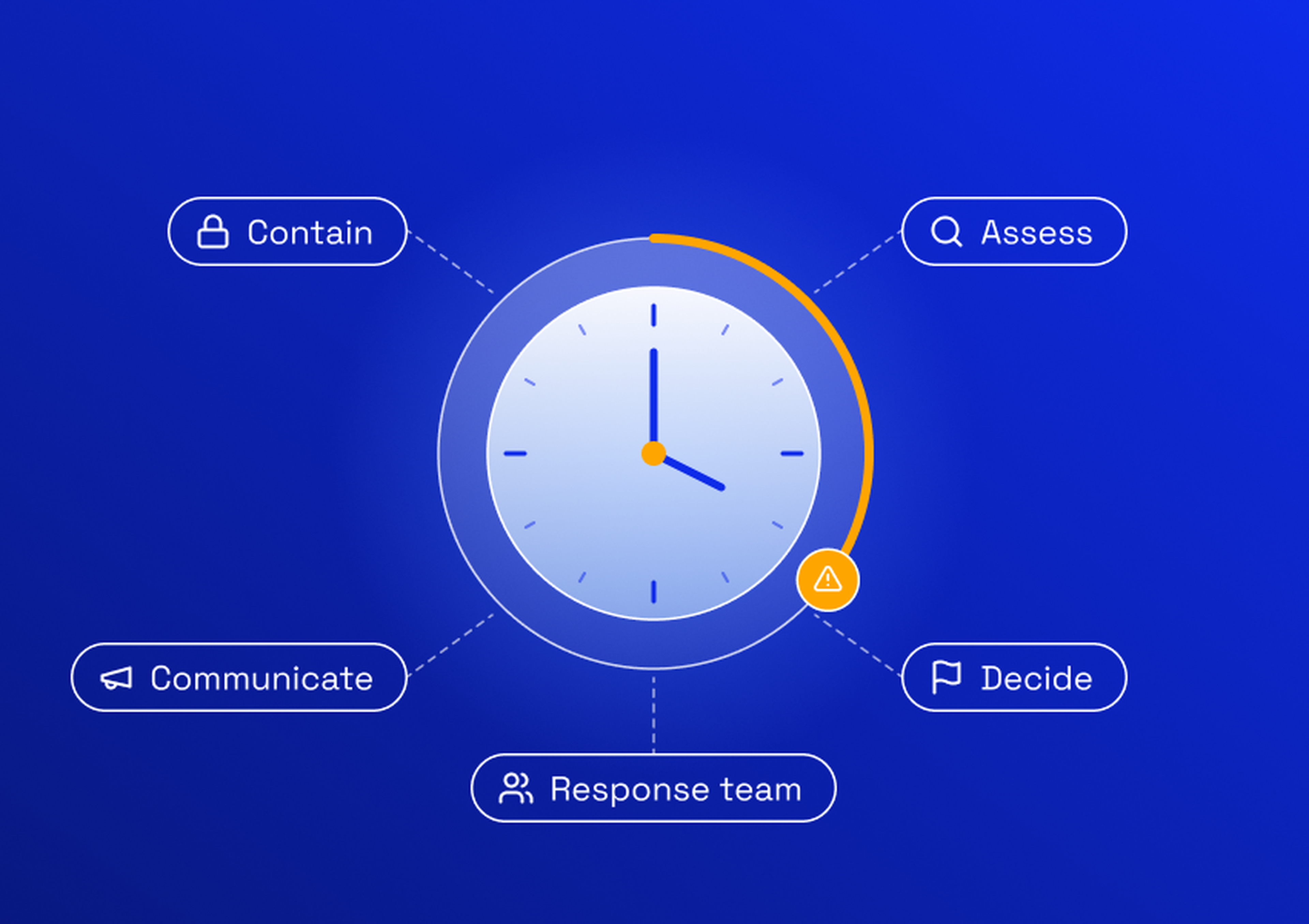
The first hours of a cyber crisis determine the total cost of the incident. They are not the hours when you choose a tool: they are the hours when you decide what to shut down, whom to inform and on what information.
A prepared organization knows who decides, how to isolate, what to record and whom to notify. An unprepared one spends those hours looking for phone numbers.
What is at stake in the first hours
| Issue | Question to settle | Consequence of delay |
|---|---|---|
Qualification | Is this a security incident, and of what magnitude? | Disproportionate or late response |
Containment | What needs isolating, and at what business cost? | Spread to other systems |
Evidence preservation | What has to be preserved before acting? | Investigation impossible, imprecise notification |
Continuity | Which activities continue, in degraded mode? | Broader shutdown than necessary |
Communication | Who is informed, internally and externally? | Loss of trust, contradictory information |
Notification | Which obligations apply, within what deadlines? | Regulatory breach |
These six decisions have to be prepared in calm conditions. Taken under pressure without a framework, they contradict each other.
What a crisis framework should contain
NIST proposes an incident handling structure in phases: preparation, detection and analysis, containment, eradication and recovery, then lessons learned. That sequence provides a useful frame for organizing roles and decisions.
Seven elements to formalize:
1. Roles: who decides, who investigates, who communicates, who documents
2. Activation criteria: at what signal the crisis unit is stood up
3. Crisis directory: internal contacts, providers, insurer, authorities, held outside the corporate directory
4. Isolation procedures: how to isolate a system, a site, an account, with the associated business impact
5. Crisis log: format for recording decisions, timestamps and findings
6. Fallback channels: communication means usable if email is compromised
7. Notification obligations: authorities, customers, partners, insurer, with applicable deadlines
Point three deserves emphasis. A crisis directory stored only inside the compromised environment is unusable at the moment it becomes necessary.
Key takeaways
-Six decisions play out in the first hours; all of them are prepared in advance.
-A crisis directory has to exist outside the information system.
-Recording decisions and timestamps determines both investigation and notification quality.
The skills to mobilize
| Skill | Role in a crisis |
|---|---|
Crisis coordination | Runs the unit, arbitrates, keeps the decision thread |
Investigation and forensics | Qualifies, traces origin, preserves evidence |
Operational security | Isolates, hardens, restores |
Infrastructure and backups | Assesses restoration options and their reliability |
Communication | Internal, customers, partners, press where relevant |
Legal and compliance | Notifications, obligations, relations with authorities |
Executive management | Shutdown decisions, arbitration, committing resources |
Business and production | Impacts, degraded modes, recovery priorities |
The last two lines are the ones exercises forget. A decision to shut down a service cannot be taken by the security team alone.
How to prepare in practice
1. Write the emergency procedures. Short, operational, accessible offline.
2. Test restorations. An untested backup is not a backup. Test the full restoration of a service, not just file readability.
3. Run exercises. A tabletop exercise twice a year is enough to reveal most gaps: unclear roles, outdated contacts, no fallback channel.
4. Prepare communication templates. Internal, customer and partner messages, to be adapted rather than drafted under pressure.
5. Contract external support in advance. Incident response provider, insurer, legal counsel: intervention terms should be known before the crisis, not negotiated during it.
6. Organize the lessons learned. Without a documented post-incident review, the same causes return.
Mistakes to avoid
Improvising the decision chain. With no identified decision-maker, nobody dares shut down a service, and containment is delayed by hours.
Acting before preserving. Rebooting, reinstalling or cleaning too quickly destroys the traces needed for investigation and notification.
Communicating without coordination. Contradictory messages between teams, management and customer support deepen the loss of trust.
Neglecting the aftermath. Recovery and lessons learned are part of the crisis.
Key takeaways
-Two tabletop exercises a year reveal most of the gaps.
-Preserve before acting: premature cleaning makes investigation impossible.
-External support terms are negotiated in calm conditions.
Conclusion
Preparing for a cyber crisis rests on defined roles, accessible procedures, regular testing and a clear decision chain. The first hours cannot be improvised.
Write the procedures, test restorations, run exercises, contract external support in advance, and document every lessons-learned review.