Many organizations hold a full body of policies and still have no visibility on their actual risk level. That is the symptom of a GRC function that documents without steering.
Governance, risk and compliance, grouped under the acronym GRC, structure how an organization identifies its risks, decides its priorities and demonstrates that it meets its obligations.
The three components of GRC
Governance defines roles, forums, policies and decisions. It answers: who decides what, and on what basis?
Risk management identifies, assesses and treats risks according to impact and likelihood. It answers: what do we protect first, and why?
Compliance verifies adherence to regulatory, contractual and internal obligations. It answers: what do we need to be able to demonstrate?
All three should produce decisions, not only documents. A GRC function that has never changed a budget priority or an architecture has no measurable effect.
What to build the approach on
The NIST Cybersecurity Framework structures risk management around complementary functions: govern, identify, protect, detect, respond and recover. That structure helps cover the domains without treating them in silos.
A framework is not deployed in full. It serves as a reading grid to spot what is missing, then to prioritize. An organization that adopts a framework without connecting it to its essential activities produces a generic action plan.
Key takeaways
-Each of the three components answers a distinct question; conflating them produces documentation without arbitration.
-A framework is a reading grid, not a deployment plan.
-The validity test for GRC: has it ever changed a budget priority?
The steps of a GRC action plan
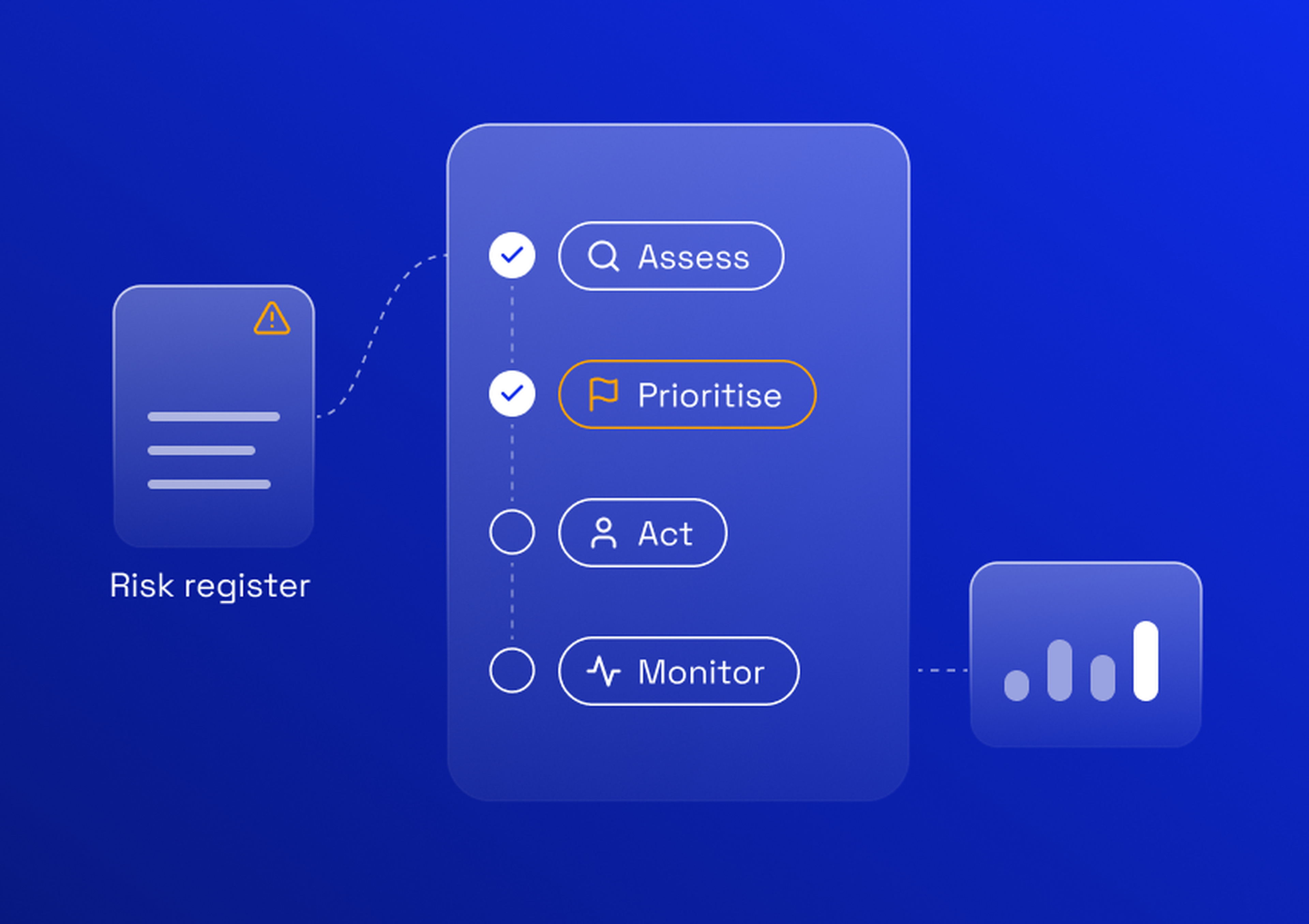
1. Map essential activities. Identify what, if halted, affects customers, revenue, personal safety or compliance. Everything else follows from that.
2. Identify risk scenarios. Express them as concrete events rather than abstract threats: unavailability of a billing system, compromise of an administrator account, leak of a customer file, stoppage of a production line.
3. Assess impact and likelihood. Use a simple, shared scale. A complex scale produces debates about method rather than decisions.
4. Define measures and owners. Each measure needs a named owner, a deadline and an estimated cost.
5. Prioritize. Combine risk level, effort and time. Sequence in three waves rather than one long list.
6. Monitor and report. A steering forum, indicators, periodic review, traced decisions.
| Wave | Selection criterion | Example content |
|---|---|---|
Wave 1 | High risk, manageable effort | Privileged access review, restoration tests, MFA on critical access |
Wave 2 | High risk, significant effort | Network segmentation, extended monitoring, supplier requirements |
Wave 3 | Moderate risk or dependent on earlier waves | Automation, industrialization, certification |
The skills to mobilize
| Skill | Contribution |
|---|---|
Risk analyst or consultant | Scenarios, assessment, treatment plan |
Compliance lead | Applicable obligations, evidence, relations with authorities |
Operational security expert | Technical feasibility, costing, implementation |
Internal or external auditor | Independent control, findings, remediation follow-up |
Programme manager | Coordination, prioritization, reporting |
Procurement lead | Supplier requirements, clauses, assessment |
Executive management | Arbitration, budget, risk appetite |
Risk appetite is the contribution most often missing. Without an explicit position from management on what is acceptable, every trade-off is re-litigated case by case.
Mistakes to avoid
Producing a framework before a diagnosis. Policies written without risk analysis are not applied, because they match no identified priority.
Confusing an indicator with evidence. Antivirus coverage is an indicator. A restoration test report is evidence. Both are useful; they are not interchangeable.
Steering GRC away from operational security. An action plan not costed by the people who have to implement it stays an intention.
Treating audit as a threat. Audit findings are the most reliable available information on the gap between policy and practice.
Key takeaways
-Express risks as concrete events, not abstract threats.
-Sequence in three waves based on the risk and effort pairing.
-Have management state its risk appetite before prioritizing.
Conclusion
A useful GRC approach connects real risks to decisions and resources. It produces trade-offs, evidence and tracked remediation, not a body of policies.
Start from essential activities, express concrete scenarios, sequence in waves, and have management state its risk appetite.