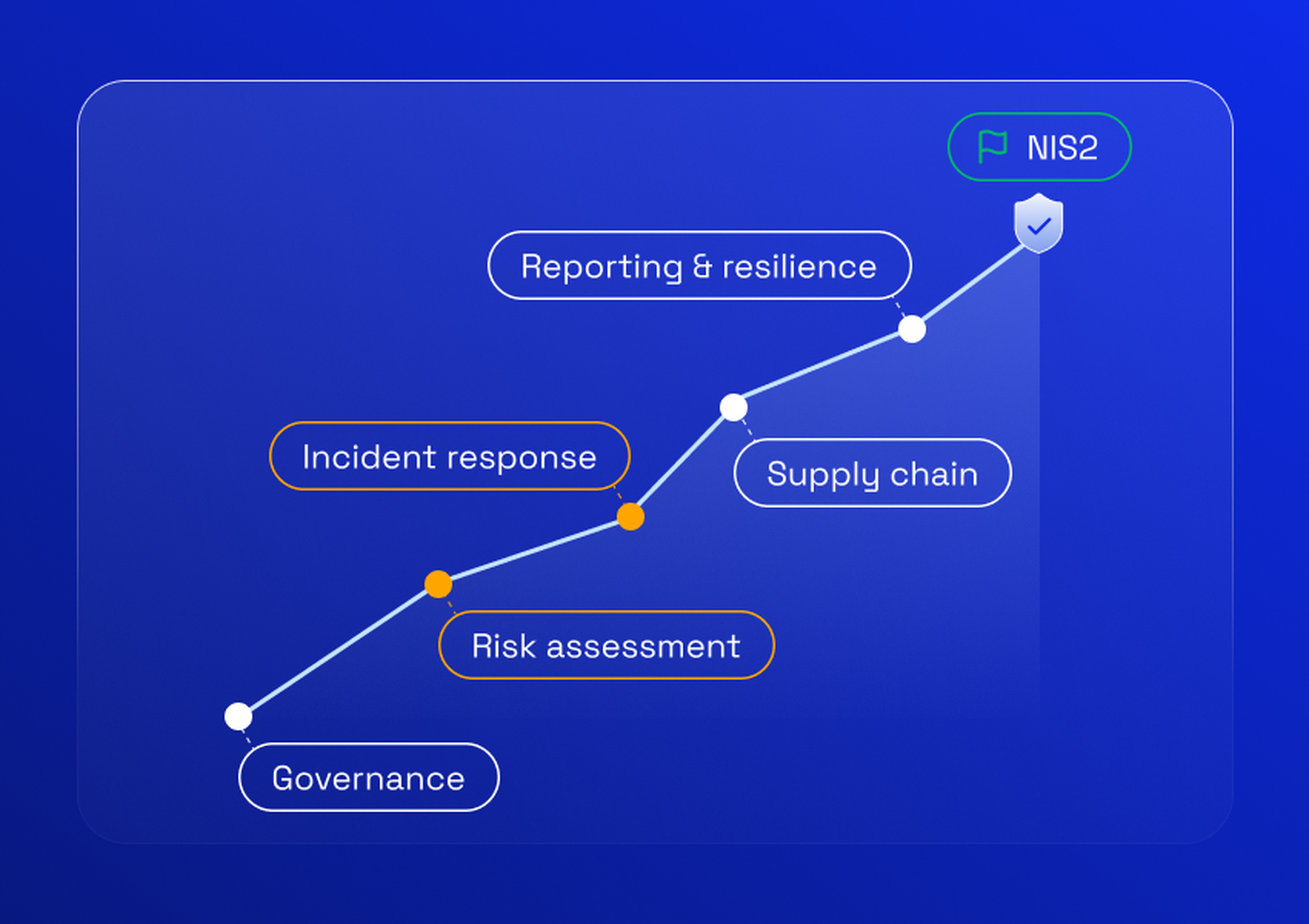
NIS2 does not ask for a document. It asks for a demonstrable capability. That shift explains why many organizations with an up-to-date security policy discover they are not ready.
The European directive raises cybersecurity requirements for a wide range of entities and increases expectations around risk management, incident handling and management accountability. Compliance therefore mobilizes technical, organizational and legal skills.
What NIS2 changes
NIS2 widens the scope of entities covered, strengthens risk management measures and clarifies incident notification obligations. It also places the accountability of management bodies at the centre of the framework.
National transposition and sector-specific frameworks set out how it applies. Have the scope, timeline and thresholds applicable to your organization rechecked by your legal team or your national competent authority before publication, and at every update of this article.
In practice, the directive shifts attention in three ways:
• From policy to evidence: measures have to be demonstrably applied, not only decided
• From internal scope to the supply chain: suppliers enter the risk analysis
• From the security team to the board: accountability moves up to management bodies
The domains to cover
| Domain | Expected | Typical evidence |
|---|---|---|
Governance and risk | Risk analysis, policies, management involvement | Risk map, committee minutes |
Incident management | Detection, qualification, notification, lessons learned | Procedure, incident log, exercises |
Business continuity | Backups, restoration, recovery plans | Documented restoration tests |
Supply chain security | Supplier requirements, assessment, clauses | Questionnaires, contract clauses, reviews |
System and network security | Hardening, patching, segmentation, logging | Inventory, patch plans, configurations |
Access management | Named permissions, strong authentication, reviews | Traced entitlement reviews |
Awareness and training | Role-based programme, including for directors | Completion rates, content, assessments |
The evidence column is what most organizations lack. From an inspection standpoint, a measure that is applied but undocumented is a measure that is absent.
Key takeaways
-NIS2 shifts the requirement from policy to evidence.
-The supply chain enters the risk scope explicitly.
-Accountability moves up to management bodies, which changes the nature of budget trade-offs.
The skills to mobilize
| Skill | Role in the compliance programme |
|---|---|
GRC and risk management | Risk analysis, policies, action plan, indicators |
Operational security | Hardening, patching, segmentation, monitoring |
Detection and incident response | Detection, qualification, investigation, notification |
Continuity and resilience | Backups, restoration tests, recovery plans |
Supplier security and procurement | Requirements, assessment, clauses, follow-up |
Legal and compliance | Interpreting obligations, notifications, documentation |
Programme management | Coordination, prioritization, reporting to the board |
Awareness | Role-differentiated programmes |
Programme management is the most underestimated. A NIS2 programme touches IT, security, procurement, legal, business teams and the board: without dedicated coordination, the workstreams advance at incompatible speeds.
How to organize the programme
1. Qualify the scope. Determine whether the organization is covered, on what basis and against which thresholds. This step is done with legal, not alone.
2. Run a gap assessment. Compare existing measures against the requirements, domain by domain, distinguishing what is applied, what is applied without evidence, and what is absent.
3. Prioritize by risk. Address what protects essential activities and what is most exposed first, not what is easiest to document.
4. Build the team. Identify available internal skills and the gaps. External support is useful on risk analysis, audit, detection and remediation.
5. Establish the evidence chain. Each measure should produce a verifiable artefact: procedure, log, test report, review minutes.
6. Involve the board formally. Steering committee, traced decisions, documented budget trade-offs.
Mistakes to avoid
Treating NIS2 as a documentation project. Producing policies without changing practice creates an additional risk: the gap between the document and reality becomes an audit finding in itself.
Ignoring suppliers. Supply chain requirements imply questionnaires, clauses and follow-up. That concerns procurement as much as security.
Neglecting restoration tests. An untested backup is not a backup.
Undersizing detection. Notification obligations assume a capacity to detect and qualify within short deadlines.
Key takeaways
-Use three states in the gap assessment: applied and evidenced, applied without evidence, absent.
-Prioritize by risk, not by ease of documentation.
-Each measure has to produce a verifiable artefact, otherwise it does not count.
Conclusion
NIS2 compliance is a programme, not a document. It requires risk analysis, a prioritized plan, identified skills and an evidence chain that holds up under inspection.
Qualify your scope with legal, measure the gap while distinguishing evidence from intention, then fill the skill gaps.