Choosing an analytics platform commits an organization for years. It also commits it, less visibly, to a specific skill profile. A team hired around one platform does not transfer mechanically to another.
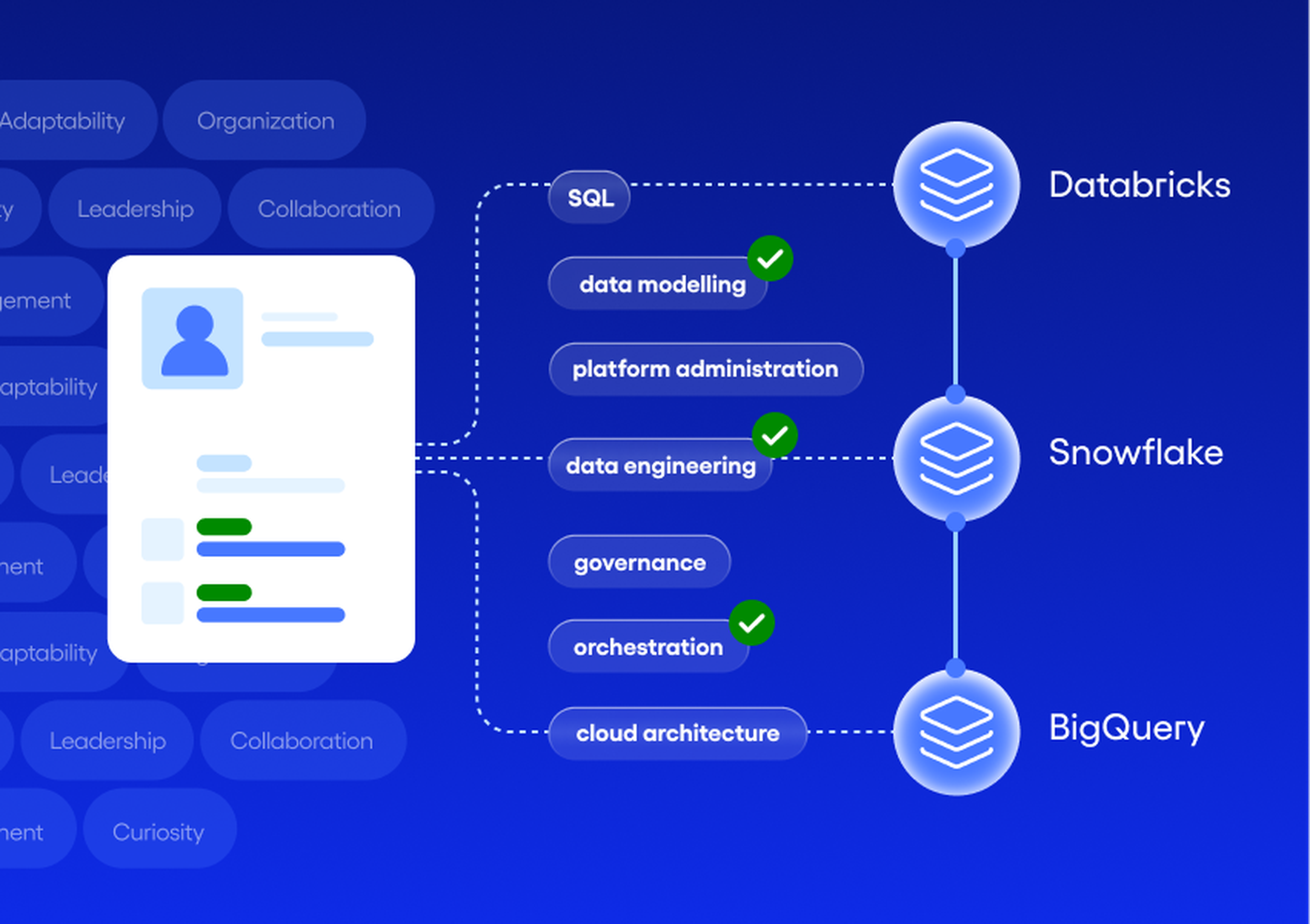
Databricks, Snowflake and BigQuery rest on different technical models. The skills to look for differ as much as the architectures.
What separates the three platforms
Each platform has its own logic: distributed processing and analytics unification for Databricks, a cloud warehouse with separated storage and compute for Snowflake, a serverless warehouse integrated into Google Cloud for BigQuery.
| Platform | Dominant logic | Consequence for skills |
|---|---|---|
Databricks | Distributed processing, lakehouse, unified data and AI | Spark, open table formats, job optimization, orchestration, MLflow |
Snowflake | Cloud warehouse, separated storage and compute | Advanced SQL, modelling, virtual warehouse sizing, data sharing |
BigQuery | Serverless warehouse, Google Cloud integration | SQL, partitioning and clustering, IAM, command of the billing model |
These differences go beyond syntax. They concern architecture, performance, security and the cost model, which are the four areas where a mistake is expensive and slow to correct.
Skills common to all three environments
Whatever the choice, some skills remain essential and transferable.
• Data modelling: layers, granularity, history, reusability
• Advanced SQL and optimization: reading execution plans, rewriting expensive queries
• Ingestion and orchestration: dependencies, recovery, idempotency
• Quality and testing: checks on critical fields, thresholds, alerts
• Security and access management: named permissions, isolation, traceability
• Cost control: consumption tracking, usage trade-offs, alerting
• Documentation and handover: conditions for another team to take over
These form the base. What varies is the platform-specific skill set and the sizing reasoning behind it.
Key takeaways
-The base is transferable; sizing and optimization are not.
-Four areas concentrate the risk: architecture, performance, security, cost.
-An expert experienced on one platform needs ramp-up time on another. Plan for it.
Platform-specific skills to look for
On Databricks. Command of Spark and its execution plan, open table formats, cluster and compute policy management, workflow orchestration, experiment and model tracking. The rare skill is not writing Spark, it is diagnosing a slow or expensive job.
On Snowflake. Advanced SQL, modelling, virtual warehouse management and sizing, access control, data sharing between entities. The sensitive point is consumption: an oversized warehouse or a badly written query is paid for immediately.
On BigQuery. SQL, partitioning and clustering, fine-grained identity and access management, and an understanding of the billing model and its cost controls. The differentiating skill is designing a data model that mechanically limits scanned volumes.
How to formulate the requirement
Describe your environment before naming a technology. A requirement stated as “Snowflake expert” gives you no basis to compare two candidates; a requirement stated as “halve the cost of three daily pipelines on Snowflake without degrading freshness” does.
Seven elements to include in a brief:
1. Data sources and volumes
2. Expected refresh frequency
3. Number and type of users, main use cases
4. Transformation, orchestration and visualization tooling in place
5. Security, data location and compliance requirements
6. Cost constraints and current billing model
7. Expected outcome of the engagement and associated deliverables
State whether you are looking for design, migration, optimization or operating expertise. Those are four distinct engagements, with four profiles and four seniority levels.
Mistakes to avoid
Hiring a technology rather than a way of reasoning. A platform certificate says nothing about the ability to arbitrate between cost, freshness and complexity.
Underestimating cost as a skill. On all three platforms, the bill is a direct consequence of modelling choices. An expert who cannot explain where a consumption line comes from will not be able to reduce it.
Neglecting security and isolation. Permission models differ substantially between platforms.
Forgetting the handover. An undocumented optimization degrades as soon as the team changes. Require documentation of the choices, not only the result.
Key takeaways
State a measurable outcome, not a technology name.
-Design, migration, optimization and operation are four distinct engagements.
-On these three platforms, cost control is a technical skill, not a finance topic.
Conclusion
Each analytics platform imposes its own requirements on architecture, performance, security and cost. Sourcing should therefore start from the real environment and the expected outcome.
A common base exists and transfers. Platform-specific skills are verified on a concrete case.