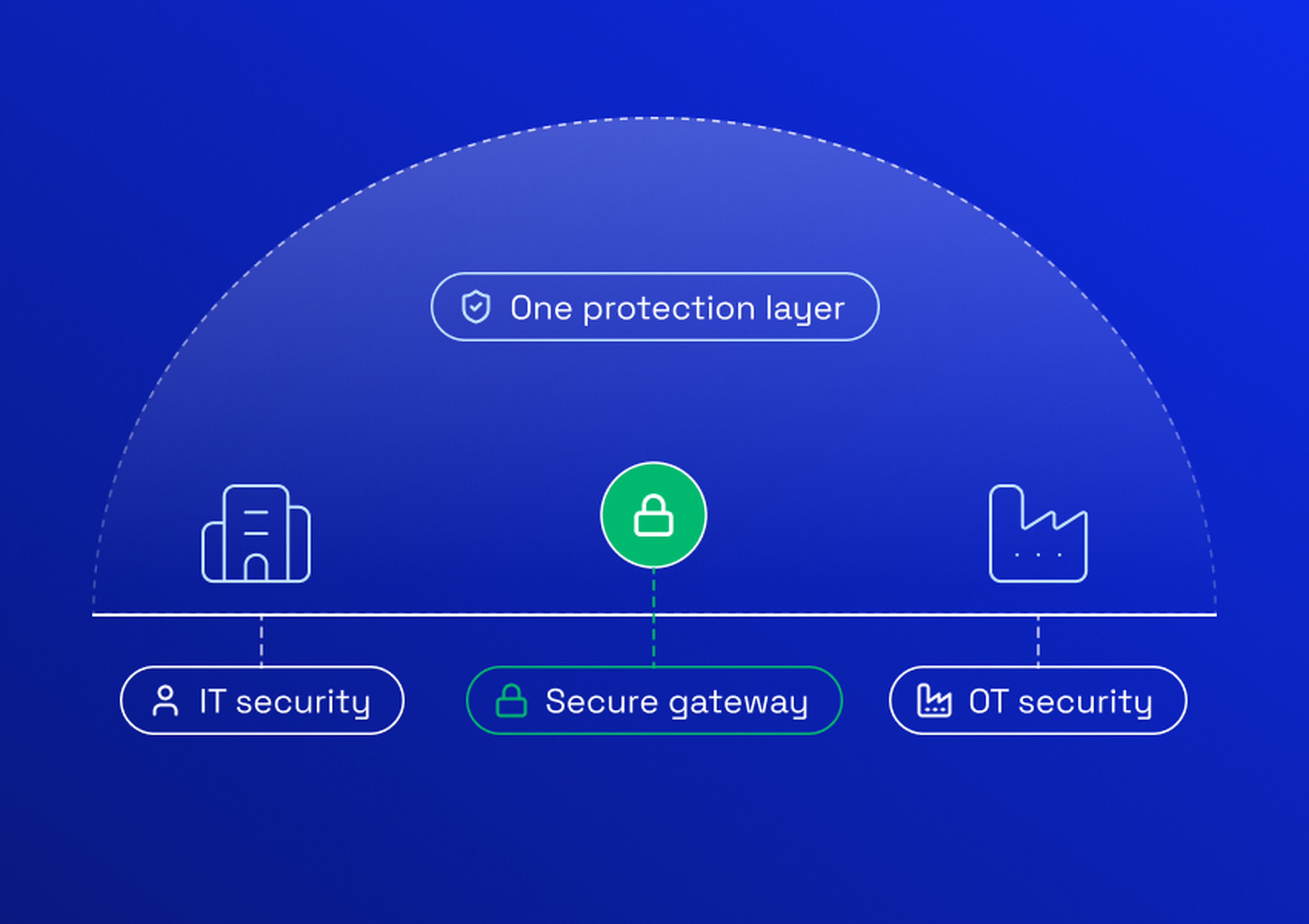
In corporate IT, the priority is confidentiality. In an industrial environment, it is availability and personal safety. That inversion explains why IT security practices do not transfer mechanically onto a production site.
Industrial environments rely on control systems, programmable controllers and equipment whose service life far exceeds that of conventional information systems. Securing them requires hybrid skills, between IT and industrial automation.
What separates OT from IT
| Criterion | IT, corporate systems | OT, industrial systems |
|---|---|---|
Priority | Confidentiality, integrity, availability | Personal safety, availability, integrity |
Equipment lifecycle | 3 to 5 years | 10 to 25 years |
Patch window | Frequent, plannable | Rare, often tied to production shutdowns |
Interruption tolerance | Low but real | Often zero |
Protocols | Standard and documented | Often proprietary or legacy |
Consequence of an incident | Data loss, unavailability | Production stoppage, physical risk |
These differences have a direct consequence: a conventional vulnerability scan can disrupt a controller, and a patch applied without vendor validation can void a warranty or a safety certificate.
The skills to mobilize
| Skill | Contribution |
|---|---|
Knowledge of industrial systems | Controllers, supervision, protocols, safety constraints |
Industrial network architecture | Segmentation, zones and conduits, interconnection points |
Adapted operational security | Hardening and patch management under production constraints |
Detection in OT environments | Passive monitoring, traffic analysis, adapted alerting |
Industrial crisis management | Coordination across security, production, maintenance, health and safety |
Compliance and standards | Sector frameworks and industrial security standards |
Remote access security | Vendor interventions, remote maintenance, third-party accounts |
The last line deserves particular attention. Remote maintenance access held by equipment manufacturers and integrators is one of the most frequent entry paths, and one of the least governed.
Key takeaways
-In OT, the priority is personal safety and continuity, not confidentiality.
-IT security tools can disrupt a controller: passive monitoring is often the only option.
-Vendor remote maintenance access is a recurring blind spot.
How to structure the approach
1. Inventory equipment and flows. Controllers, supervision, engineering workstations, networks, measurement devices, remote access. On an older site, this inventory is often the project’s most valuable deliverable.
2. Map zones and conduits. Define trust zones and the exchange points between them, using industrial security frameworks as a guide.
3. Prioritize by impact on production and on people. The criterion is not data sensitivity but the consequence of a stoppage or a malfunction.
4. Govern remote access. Named accounts, strong authentication, recorded sessions, authorization per intervention, systematic revocation.
5. Deploy adapted detection. Favour passive traffic monitoring and behavioural deviation analysis over active tools.
6. Prepare joint crisis management. Scenarios have to bring together security, production, maintenance, quality and health and safety, with clear stop criteria.
7. Embed requirements in supplier contracts. Integrators, manufacturers and maintenance providers work on these systems: their obligations have to be contractual.
Mistakes to avoid
Transferring IT tools as they are. An active scan, an agent installed on an engineering workstation or an automatic patch can cause the very incident it was meant to prevent.
Addressing OT without the production teams. Production managers know the shutdown constraints, the dependencies and the safety procedures. Without them, the security plan is unworkable.
Ignoring engineering workstations. These are often the oldest machines, the most critical and the least monitored.
Deferring segmentation. A flat industrial network propagates an incident across the whole site. Segmentation is the action with the widest effect.
Leaving remote access ungoverned. A permanent, shared and untraced vendor account cancels out most of the other measures.
Key takeaways
-The inventory is the first deliverable and often the most revealing.
-Prioritize by impact on production and people, not by data sensitivity.
-Segmentation remains the action with the widest effect.
Conclusion
Industrial cybersecurity requires specific skills and close coordination between security, production and maintenance. The priorities invert compared with IT, and tools have to adapt to field constraints.
Start with the inventory and segmentation, govern remote access, and involve production in every decision.