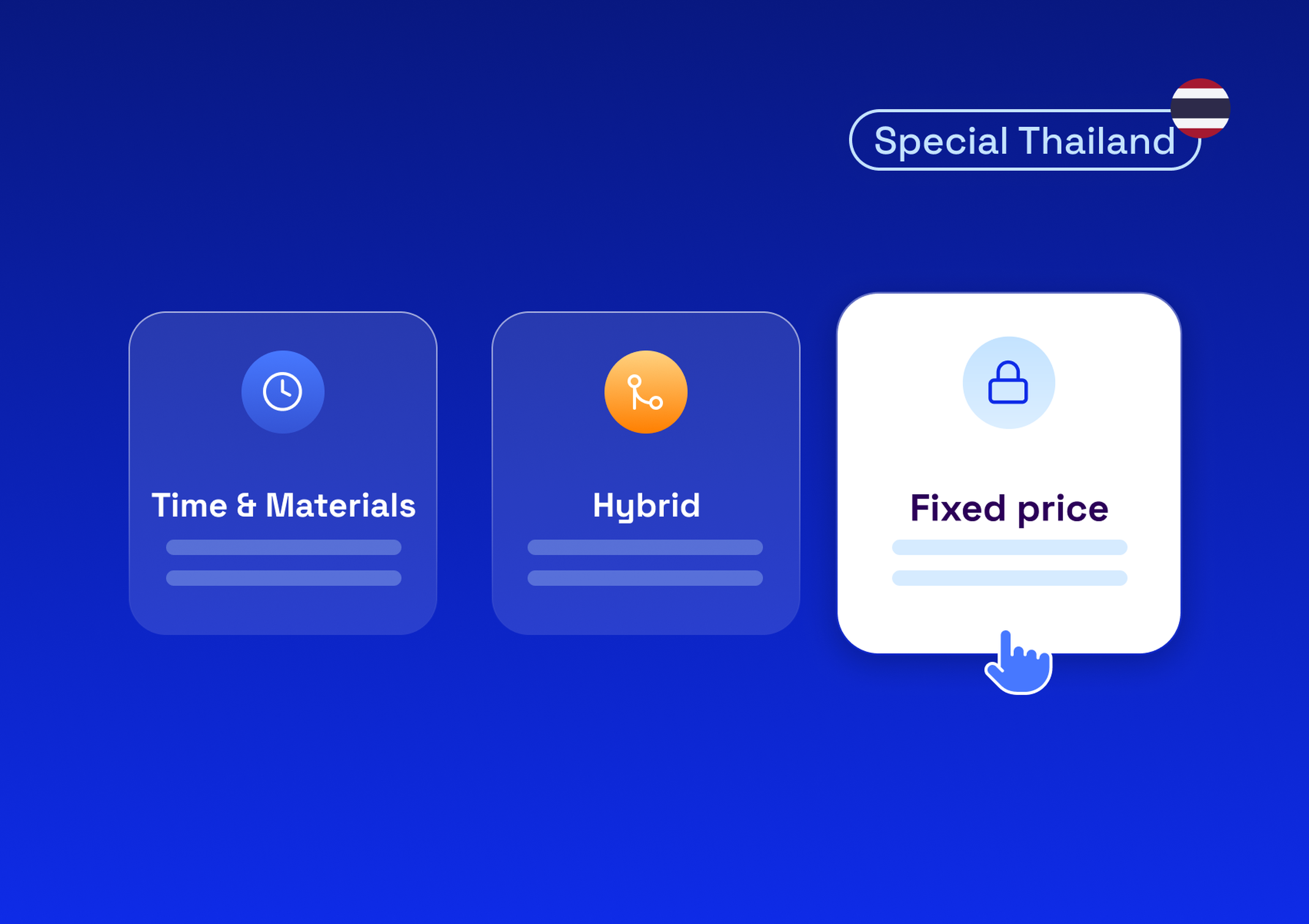
Fixed price or Time & Materials is the first contract decision on almost every IT project, and it determines who pays when things change. Choose well and you get either predictable delivery or useful flexibility. Choose badly and you pay for it in disputes, budget drift or both. This guide helps procurement and IT leaders decide with a simple method.
What each model means in an IT project
A fixed price contract sets one price for a defined scope and deadline, so the provider carries the cost risk. A Time & Materials contract pays for the effort actually spent, usually at daily or hourly rates, so the client carries the budget risk. The right choice depends mainly on how clear the scope is.
In an IT project, “materials” usually means the elements beyond labor: software licenses, cloud usage, test environments or third-party tools. Under Time & Materials, these are billed at cost or at an agreed margin, next to the time spent by the team.
Both models are legitimate and both are widely used. The mistake is to treat one as the safe default. Each one protects a different party, and each one fails in a predictable way.
Fixed price: where it protects you and where it hurts
A fixed price contract gives the buyer a known total cost and a committed delivery date. For a procurement team, this is easy to approve, easy to budget and easy to compare across offers. It works best when requirements are written down, stable and agreed by every stakeholder, for example a migration with a clear perimeter or an integration between two documented systems.
The weakness appears the moment the scope moves. Providers who price a fixed contract usually add a margin for uncertainty, and they defend the scope strictly because every extra task cuts into their own result. Each change request becomes a negotiation. If the original specification was vague, the argument is not about price but about what was included in the first place.
A fixed price contract also tends to push quality questions into the background. When the provider’s margin depends on finishing quickly, shortcuts in testing or documentation become tempting unless acceptance criteria are precise.
There is a second effect that buyers underestimate. A fixed price contract makes the provider the owner of the plan, since it is their cost that suffers if the plan slips. That is comfortable until you want to reprioritize. Asking for a different order of delivery, even at constant scope, is a change request in a fixed price world.
Time & Materials: where it protects you and where it hurts
With Time & Materials, you pay for what is actually done. This suits work where the answer is not known at the start: a product that will evolve, a discovery phase, a modernization where the existing system must be explored first. You can reprioritize every sprint without renegotiating a contract.
The risk moves to the buyer. Without a budget cap, regular reporting and a person who validates the work, costs grow silently. The provider has no direct incentive to finish early, and you may only notice the drift when most of the budget is spent. Time & Materials is therefore not a cheaper or looser option. It demands more management from your side, not less.
The honest test is whether you have someone who will read the weekly report. If nobody does, Time & Materials becomes an open budget, and the model will be blamed for a governance failure.
A decision grid for choosing the model
The table below turns the choice into four practical questions. Answer them honestly, with both IT and procurement in the room.
| Question | If the answer is yes | Leans toward |
|---|---|---|
Can the full scope be described in writing today? | Requirements are documented and agreed | Fixed price |
Will requirements probably change during the project? | The business is still learning what it needs | Time & Materials |
Do you have someone able to manage and validate the work weekly? | An internal lead exists | Time & Materials is manageable |
Is a fixed total budget a hard constraint? | Approval depends on one number | Fixed price, with a well-written scope |
If your answers point in different directions, that is a signal rather than a problem. It usually means a hybrid model will serve you better than either extreme.
Hybrid models: discovery first, build second
A common and effective pattern is to split the project. The first phase, discovery or specification, runs under Time & Materials with a limited budget. Its output is a precise scope, a prototype or a technical design. The second phase, the build, runs under fixed price based on that output.
The following example is composite and does not describe a real client.
A company wants to replace its internal order management tool. Nobody has mapped all the exceptions that sales and logistics handle by hand. Instead of asking for a fixed price on day one, the IT director funds a six-week discovery under Time & Materials. The provider documents the processes and proposes a prioritized scope. The build is then contracted at a fixed price, with acceptance criteria drawn from the discovery document. The buyer pays slightly more at the start, and avoids the far larger cost of an unclear fixed price contract.
Two variants of the same idea are worth knowing. A capped Time & Materials contract keeps the flexibility of the model but sets a ceiling the provider cannot exceed without written approval. A milestone-based fixed price splits the commitment into several smaller fixed prices, each one priced when the preceding milestone has clarified the next. Both reduce the gap between the two pure models, and both are easier to obtain than buyers assume.
Contract clauses that make either model safer
The contract can reduce most of the risk of either model. For fixed price, the essential clauses are a written definition of the scope, acceptance criteria for each deliverable and a change request procedure that states how changes are estimated, approved and invoiced. Without the last one, you will negotiate under pressure.
For Time & Materials, the key clauses are a maximum budget or a threshold that triggers a review, a reporting rhythm (weekly time and progress reports, regular demos) and a right to adjust or stop the team with reasonable notice. Add rate cards for every profile, so that a change in team composition does not change the unit price without your agreement.
| Clause | Fixed price | Time & Materials |
|---|---|---|
Scope definition | Detailed, contractual, the basis for every dispute | Directional, revisited at each review |
Acceptance | Written criteria per deliverable | Per sprint or per increment |
Budget control | The price is the control | Cap, alert threshold, monthly review |
Change management | Formal change request procedure, priced | Reprioritization within the cap |
Reporting | Milestone reporting | Weekly time and progress reporting |
Team | Provider’s choice, with a named lead | Named profiles, rate card, replacement rules |
Ending the contract | Termination and milestone payment terms | Notice period, team ramp-down |
In both cases, address ownership of the work, warranty for defects after delivery and handover obligations. These are often forgotten because they only matter at the end.
If your project needs a few senior experts instead of a full delivery contract, LittleBig Connection lets companies source freelance and consulting experts and secure the relationship through umbrella contracting, which changes the contract question entirely.
Choosing with a method, not a habit
The right contract follows the maturity of your scope. Fixed price suits a scope you can write down and agree on. Time & Materials suits a scope you are still discovering. Many projects are best served by a hybrid, with a short discovery phase followed by a fixed price build. Whichever you choose, the safeguards decide the outcome: precise scope and acceptance criteria for fixed price, budget caps and reporting for Time & Materials, and a change process in both cases.
If you are preparing an IT contract or need experts to support the project, describe your needs to the LittleBig Connection team through the contact page.
The rules that apply can vary depending on the contractual framework, the status of the provider and how the mission is organized. It is best to check these points with the HR, procurement or legal teams concerned.