IT staff augmentation in Thailand lets a company add external engineers, testers or project managers to its own team for a defined period. It is a fast way to close a skills gap, and it is easy to misuse. This guide explains when it works, what drives the price and what IT, HR and procurement teams should control.
What IT staff augmentation is
IT staff augmentation is a model in which an external provider supplies skilled IT professionals who join your team and work under your direction, usually for a fixed period. You manage the tasks and priorities, while the provider handles recruitment and contracting of the people.
The key point is the split of responsibility. In staff augmentation, you buy capacity and skills, not a guaranteed result. The augmented developer works in your backlog, follows your standards and reports to your lead. If the project is late, the responsibility stays with you.
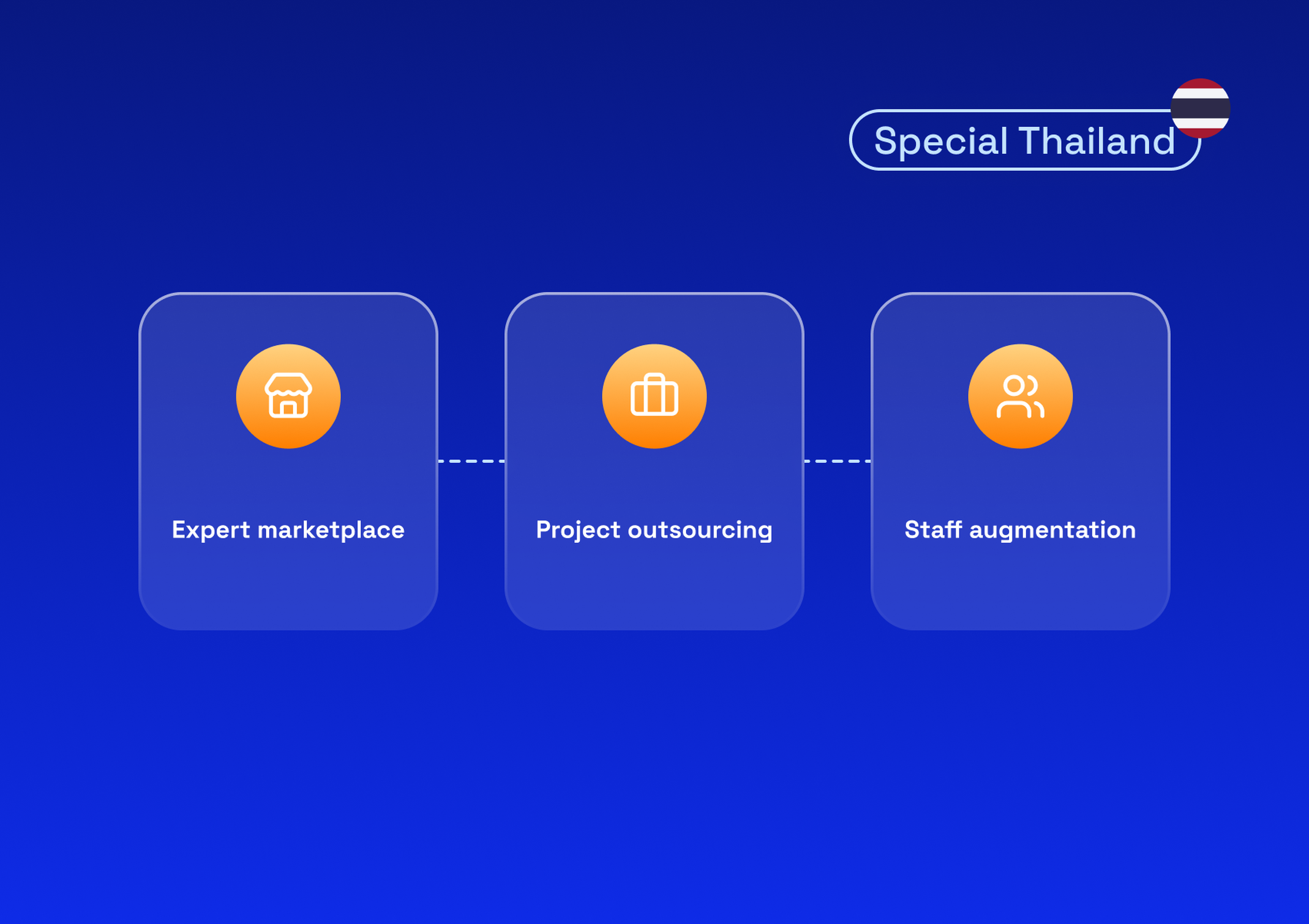
This is the main difference from project outsourcing, where the provider answers for a result or a service and organizes the work to get there. The two are often sold by the same firms, sometimes under the same commercial header, and the distinction only becomes visible in the contract.
When staff augmentation is the right choice
Staff augmentation works best when you know what you need and have someone able to manage it. A typical case is a product team that lacks two backend engineers for six months, or a security project that needs a specialist for a defined phase. The need is precise, the manager exists and the work fits into an existing process.
It also fits peaks of workload, such as a migration with a deadline, where hiring permanent staff would be too slow and too rigid. And it helps when a specific expertise is needed for a short time, for example a cloud architect to design a target platform before your own team takes over.
It fits poorly when you expect the provider to take responsibility for the outcome, when nobody on your side has time to direct the work, or when the need is a complete project with its own governance. In those cases, outsourcing a project or a managed service is a better match.
How much management does it actually require?
Buyers compare these models on price and speed, and are then surprised by the management load. The table below compares the three usual options on what they ask of your own organization, week after week.
| What it asks of you | Staff augmentation | Project outsourcing | Independent experts |
|---|---|---|---|
Who sets the weekly priorities | Your team lead | The provider’s project manager | Your team lead |
Onboarding effort | Full, as for a new joiner | Limited to the interfaces | Full, usually shorter |
Time to supervise, per person | Daily, inside your rituals | Weekly or biweekly reviews | Daily to weekly, depending on seniority |
Who checks the quality of the work | You | The provider, then you at acceptance | You, with the expert accountable for their own work |
Who carries the deadline | You | The provider, within the agreed scope | You |
Effort to replace someone | Provider replaces, you re-onboard | Invisible to you | New sourcing cycle |
Knowledge retention when it ends | Depends entirely on your rules | Weak unless the contract forces handover | Depends on your rules |
Read it as a budget of attention rather than a ranking. Staff augmentation is the model that costs the least to buy and the most to run.
How pricing works
Pricing for staff augmentation is usually based on a daily or monthly rate per profile, which depends on the seniority, the technology, the length of the commitment and the contractual structure. A senior specialist in a scarce technology costs more than a mid-level developer, and a six-month engagement is priced differently from a two-week one.
Several elements sit around the rate and should be clarified early. These include the provider’s margin or fee, the minimum duration, the notice period for ending or replacing a profile, the conditions for replacing someone who does not fit, and any extra charges for equipment, software access or travel. A low headline rate can hide costs in these details.
In the Thai market specifically, a few factors move the rate more than the job title does. Command of English at working level, since much of the documentation and many of the teams are international. Scarcity of the technology rather than years of experience, which is why two profiles with the same seniority label can be priced very differently. Whether the person works on your premises in Bangkok or remotely from another province or country. And whether the provider is contracting a Thai national or a foreign professional, since work authorization has a cost and a lead time that end up in the rate.
Published market rates vary widely depending on the source, the period and the profile, so the most reliable method is to ask several providers for rate cards and compare them on the same profile description. Insist on the same wording for the role, the technologies and the seniority, otherwise you will be comparing three different jobs.
When comparing offers, look at the total cost over the engagement, including your own management time and the cost of onboarding. A cheaper profile who needs more supervision may cost more in the end.
What to control during the engagement
Staff augmentation fails less often because of technical weaknesses than because of weak management. Four areas deserve attention.
The first is onboarding. An external engineer who waits two weeks for access, documentation and a point of contact is a cost without output. Prepare the access and a first task before the person arrives.
The second is integration into the team. Augmented staff should take part in your rituals, reviews and standards, rather than working in isolation. The third is knowledge transfer. When the engagement ends, the knowledge they built should stay with you through documentation, code reviews and shared ownership. The fourth is ownership of the work: the contract should state that code, documents and deliverables belong to your company.
The following example is composite and does not describe a real client.
An IT director adds three developers to a product team for a nine-month project. The developers are productive, but they work on a separate branch, their documentation is minimal and only one of them is paired with an internal engineer. When two of them leave at the end of the contract, the team discovers that part of the logic is understood by nobody inside the company. A simple rule, such as pairing each external developer with an internal one and requiring documentation as part of the weekly work, would have kept the knowledge in-house.
Employment status and compliance: what HR should check in Thailand
For HR teams, the main question is the status of the people who work in your team. Depending on the structure, the person may be employed by the provider, engaged as an independent contractor or placed through another contractual arrangement. Each has different consequences for working conditions, direction of the work, working hours and responsibility.
Four areas should be settled before the mission starts rather than during it.
Work authorization. If the person is not a Thai national and will work in Thailand, employment of foreign nationals is regulated and a work permit, tied to an appropriate visa category, is normally required. The permit is linked to an employer and to a described role, which matters when the person is supplied by a provider but works in your offices. Lead times are not negligible, so this belongs in the project plan, not in the onboarding checklist.
The nature of the relationship. Thai labor law, like most labor law, looks at how the relationship works in practice rather than at the label on the contract. When external staff work under your direction, inside your team, with your tools and your hours, the structure needs to match what the contract says. This is the point HR and legal teams should validate first, because it is the one that is expensive to correct later.
Social contributions and tax. Contributions and withholding obligations differ depending on whether the person is employed by the provider, works as an independent contractor or is engaged through another arrangement, and depending on where the provider is established. Confirm who files what, and make sure the answer appears in the contract rather than in an email thread.
Data access. An augmented engineer usually receives the same access as an internal one. Under the Personal Data Protection Act, that access has to be covered by the contractual chain between your company, the provider and the individual. Treat access revocation at the end of the mission as part of the exit, with a date and an owner.
For companies that want to work with independent experts, LittleBig Connection offers expert sourcing and umbrella contracting to frame the contractual relationship with each expert.
What to remember
IT staff augmentation is the right choice when you know what you need, have someone to manage the work and want capacity and expertise without permanent hiring. It is not the right choice when you expect the provider to deliver a result on its own. Compare offers on total cost, control onboarding, integration and knowledge transfer, and settle work authorization and the employment relationship with HR before anyone starts.
If you need IT experts for a defined period, describe your needs to the LittleBig Connection team through the contact page.
The rules that apply can vary depending on the contractual framework, the status of the provider and how the mission is organized. It is best to check these points with the HR, procurement or legal teams concerned.