Every IT project starts with the same practical question: who will do the work, and who is responsible when it goes wrong? Outsourcing, staff augmentation and expert marketplaces are three ways to answer it, with very different consequences for cost, control and risk. This guide helps IT and procurement leaders choose, and shows how to combine them on a single project.
Three ways to staff an IT project
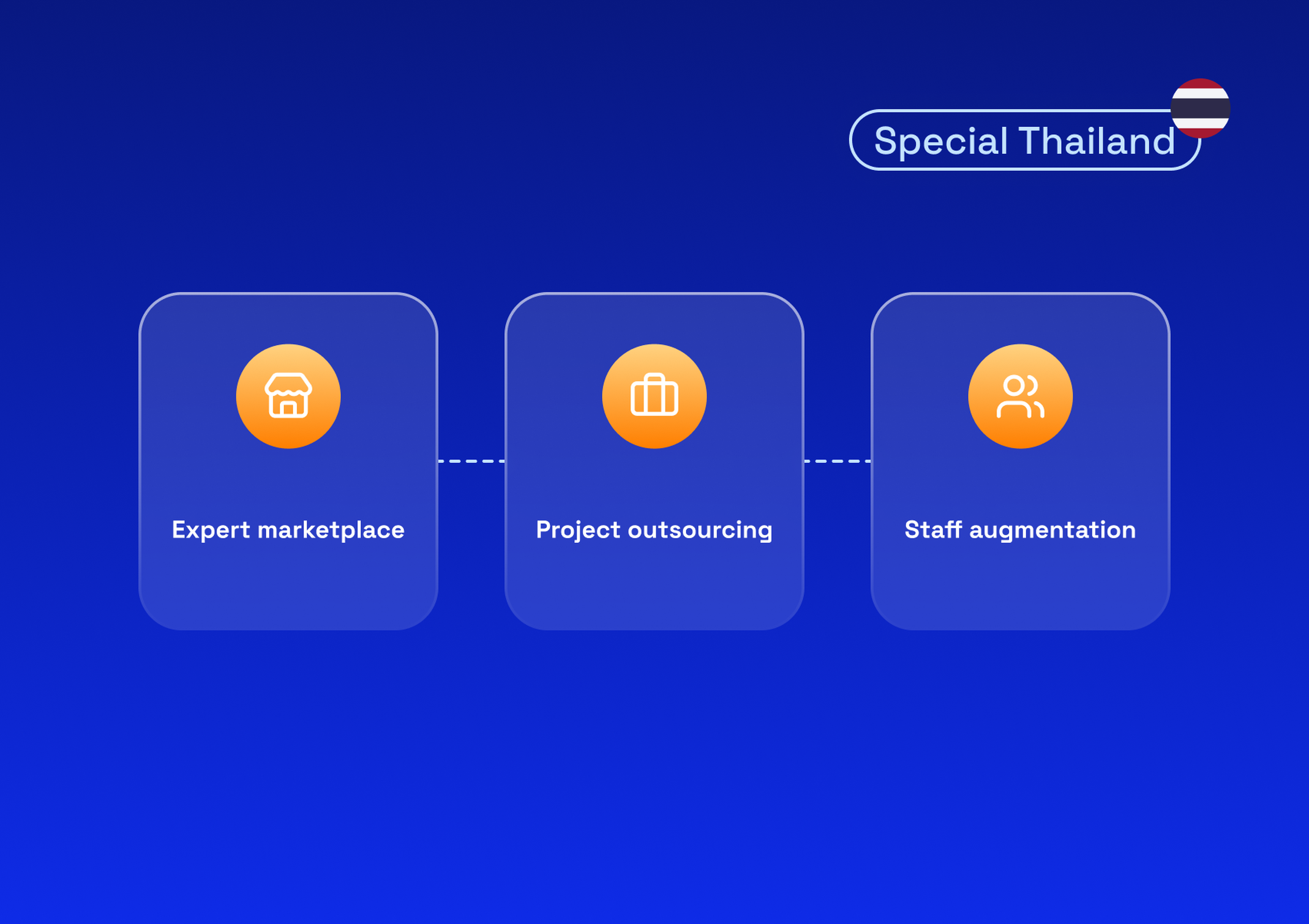
There are three main ways to staff an IT project with external help. Outsourcing hands a result or service to a provider. Staff augmentation adds provider employees to your team. An expert marketplace lets you source independent experts directly, under a contract framework.
Each model answers a different need. With outsourcing, you describe a result, and the provider organizes the work. With staff augmentation, you describe a profile, and the provider supplies a person who works under your direction. With an expert marketplace, you publish a need, receive proposals from freelance and consulting experts and choose who joins the project.
These models are often confused because they can all be invoiced at a daily rate and they can all put a person at a desk in your company. The difference is not in the invoice. It is in who directs the work, who answers for the result and who carries the contractual risk.
Who is responsible for delivery
Responsibility is the clearest way to separate the three models. In outsourcing, the provider carries responsibility for the result, within the scope and acceptance criteria written in the contract. You manage the relationship and verify the outcome, but you do not direct the daily work.
In staff augmentation, responsibility for delivery stays with you. The augmented person works in your backlog, and if the project slips, the contract with the provider does not compensate you for it. The provider is responsible for supplying a suitable profile and for the employment of the person.
With independent experts, responsibility is shared in a different way. The expert is accountable for the quality of their own work and for their professional obligations, while you direct the work and own the project outcome. A solid contractual framework is essential to clarify these points, which is the purpose of mechanisms such as umbrella contracting.
A useful test when a provider’s offer is ambiguous: ask what happens, contractually, if the work is delivered late. If the answer is a penalty or a re-performance obligation, you are buying outsourcing. If the answer is that you can replace the person, you are buying capacity, whatever the proposal is called.
The three models compared on six criteria
The table compares the models on the criteria most often used by IT and procurement teams in the decision.
| Criterion | Outsourcing | Staff augmentation | Expert marketplace |
|---|---|---|---|
Cost structure | Fixed price or Time & Materials for a project or service | Daily or monthly rate per person, plus provider margin | Daily rate negotiated with the expert, plus a framework or platform fee |
Speed to start | Depends on specification and contract | Fast if the profile is available | Fast when proposals arrive quickly, but depends on the sourcing process |
Control over the work | Low to medium | High | High |
Delivery risk | Mostly with the provider | Mostly with you | Mostly with you |
Compliance effort | Contract, data and IP clauses | Status of people, contract, data and IP | Status of the expert, contract framework, data and IP |
Flexibility | Medium | High | High |
Read the table as a map of trade-offs, not as a ranking. The model with the lowest delivery risk for you, outsourcing, is the one that gives you the least control. The models that give you the most control also ask the most of your own management.
An example: one project, three staffing choices
The following example is composite and does not describe a real client.
A company wants to build a customer analytics platform. The work can be divided into three parts, and each part suits a different model.
The first part is the design of the target architecture and the data security approach. This needs two or three senior specialists for a few weeks, and the company wants to choose them personally. An expert marketplace fits: the company defines the need, compares profiles and engages the experts directly under a clear contract.
The second part is building the platform itself. The scope is documented after the design phase, so the company contracts the build through project outsourcing at a fixed price, with acceptance criteria drawn from the architecture work.
The third part is the run phase. The company has a product owner and a team lead, but lacks two engineers to maintain and evolve the platform during the first year. Staff augmentation fits: the people join the team, work in the backlog and transfer knowledge to permanent staff during the engagement.
No single model would have served all three parts well. The result is a project where responsibility, control and cost are matched to each phase.
Mixing models without losing control
Combining models is common and sensible, but it adds a coordination duty that someone must own. Three mistakes recur.
The first is unclear interfaces. If the outsourced build team and the independent experts do not know who decides what, work is duplicated or dropped. Name one internal owner for the overall delivery, and write down who validates which decisions.
The second is inconsistent contracts. Different clauses on intellectual property, confidentiality or data protection across providers create gaps. Use a common set of requirements for every external party, and review them with your procurement and legal teams.
The third is no shared view of progress. External parties report in their own formats. Agree on one reporting rhythm and one place where the status of every workstream is visible. This is also where tools that centralize sourcing, contracts and tracking of external experts can reduce administrative load for procurement.
A fourth problem appears at the seams between phases. The architecture produced by the experts becomes the specification for the outsourced build, and the platform built by the provider becomes the system the augmented engineers maintain. Each transition is a handover, with a deliverable and an acceptance. Write them into the plan, or they will happen informally and incompletely.
How to decide in practice
Four questions usually settle the choice. How clear is the scope? How much management capacity do you have? How much delivery responsibility do you want to transfer? How fast do you need to start?
If the scope is clear and you want to transfer responsibility, lean toward outsourcing. If you know the profiles you need and can manage them, staff augmentation or independent experts fit. If you want to choose individual senior experts and keep close control, an expert marketplace is often the most direct route. If the answers differ from one part of the project to another, split the project and choose by part.
| Your situation | Likely model |
|---|---|
Scope documented, no internal capacity to manage a build | Project outsourcing, fixed price |
Scope documented, strong internal lead, work to be reprioritized | Staff augmentation or Time & Materials |
Precise skills gap in a team that already runs well | Staff augmentation |
Senior expertise for a short phase, you want to choose the person | Expert marketplace |
Scope still being discovered | Experts or Time & Materials for discovery, then decide |
Several phases with different profiles | Mix by phase, with one internal owner |
LittleBig Connection is a marketplace where companies source freelance and consulting experts, and where the contractual relationship can be framed through umbrella contracting. You can see how expert sourcing works, and browse the profiles requested in software engineering and digital transformation.
What to remember
Outsourcing, staff augmentation and expert marketplaces are not competing labels for the same thing. They differ in who directs the work, who answers for the result and who carries the contractual risk. Choose by looking at the clarity of your scope, your management capacity and the responsibility you want to transfer. When a project has several phases, mix models by phase, and name one owner for the whole.
If you are staffing an IT project and want to source experts quickly within a clear contract framework, describe your needs to the LittleBig Connection team through the contact page.