IT outsourcing in Thailand means handing part of your IT work to an external provider, from a single project to a long-term team. Finding a provider is the easy part. The hard part is choosing the right model, writing a contract that protects you and keeping control of delivery. This guide gives IT and procurement leaders a practical way to decide.
What IT outsourcing covers, and what it does not
IT outsourcing is the practice of hiring an external provider to deliver IT work, such as software development, infrastructure management or support, under a contract. In Thailand, companies use it to access skills they cannot hire fast enough, to scale teams up or down, and to keep delivery costs predictable.
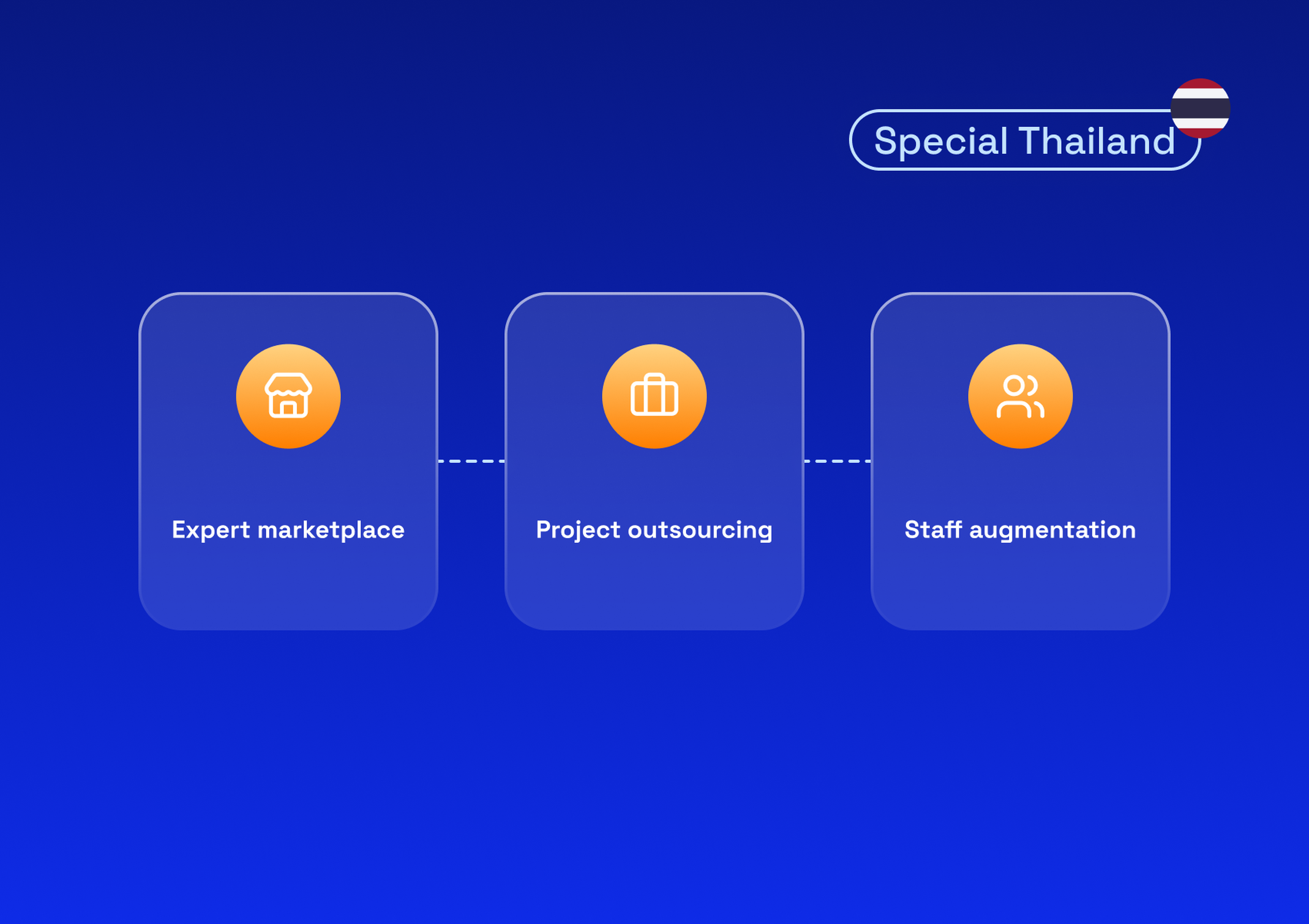
In practice, the term covers three different arrangements. In project outsourcing, the provider is responsible for a result, for example a web platform or an integration. In a managed service, the provider runs an ongoing function such as application support or infrastructure monitoring. In capacity outsourcing, the provider supplies people and you direct their work. You will also see the phrase IT business process outsourcing, which usually refers to IT-enabled processes such as a service desk handled by an outside team.
The distinction that matters is who carries responsibility for delivery. With outsourcing, the provider answers for the outcome. When you simply add people to your own team and manage them yourself, you keep that responsibility, whatever the invoice looks like. A company that buys capacity but expects a guaranteed result will be disappointed, and so will a company that buys a fixed result but keeps changing the brief.
The main IT outsourcing models used in Thailand
Providers in the Thai market usually describe their offer through a small number of engagement models. They differ mainly in who carries the risk when the scope changes. Understanding this before you contact anyone will make your conversations with providers much sharper.
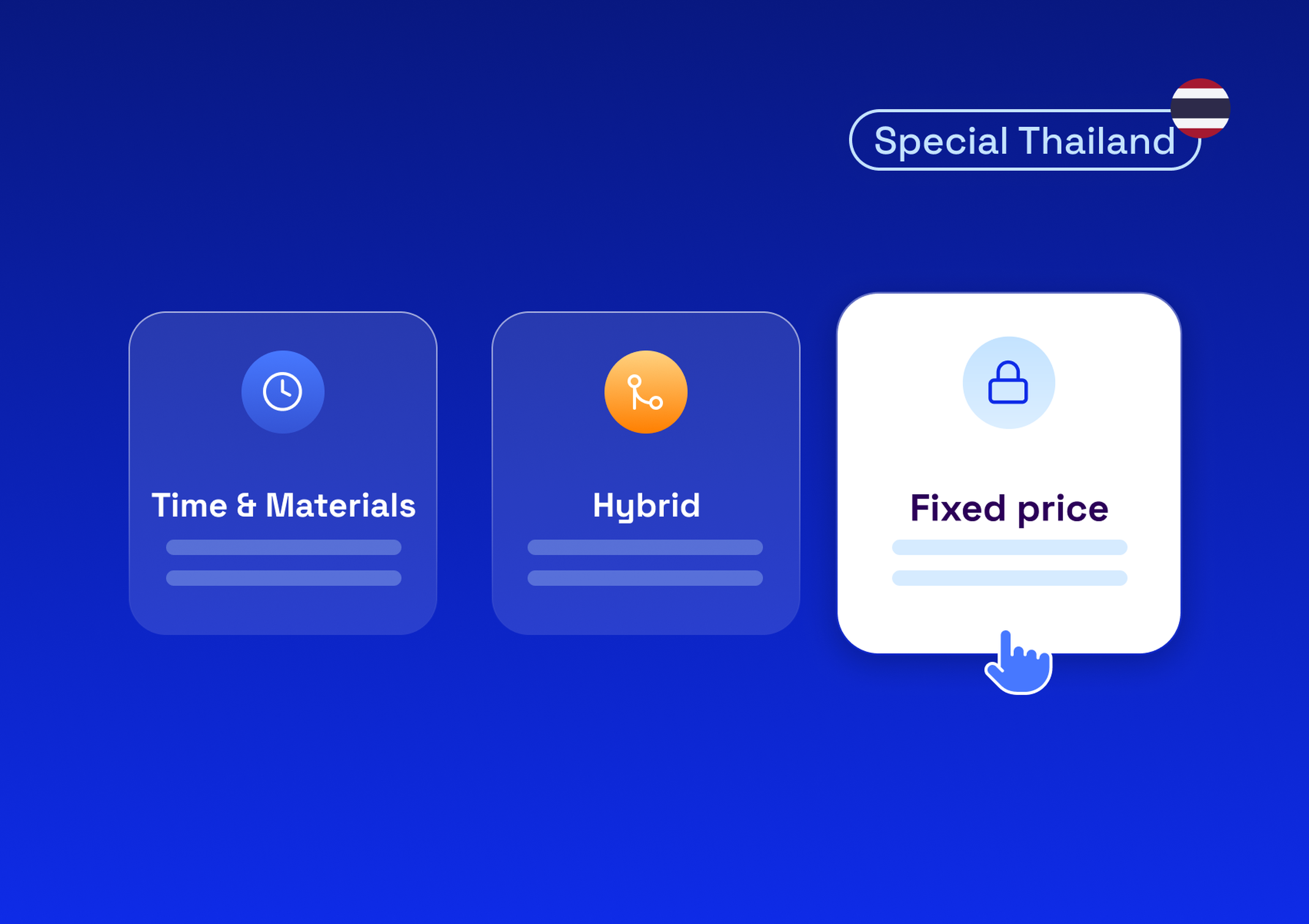
Fixed price: when the scope is clear
In a fixed price model, the provider commits to a defined scope, a delivery date and a total cost. It works well when requirements are documented and unlikely to move, such as a well-specified application or a migration with a known perimeter. The risk for you is rigidity. Every change becomes a negotiation, and a vague brief tends to turn into disputes about what was included.
Time & Materials: when the scope will evolve
With Time & Materials, you pay for the effort actually spent, usually on a monthly basis, within limits you set. It suits projects where requirements will change or where the final cost is hard to predict. The risk shifts to you: without clear budget caps, reporting and regular reviews, costs can drift.
Dedicated team and turnkey projects
A dedicated team is a group of people working only for you, which fits a company that has its own IT management and a defined strategy. A turnkey project is delivered complete, from design to handover, with the provider responsible for the whole result. Turnkey gives you less to manage but requires the most careful contract, because you depend on the provider for the full outcome.
| Model | Best when | Who carries the main risk | What to watch |
|---|---|---|---|
Fixed price | Scope is stable and documented | Provider, until the scope changes | Change request process, definition of done |
Time & Materials | Scope will evolve | You, on budget drift | Budget caps, reporting, review rhythm |
Dedicated team | Continuous work, strong internal IT lead | Shared | Team stability, knowledge transfer |
Turnkey project | You want one accountable party | Provider, but you depend on them | Acceptance criteria, handover, exit terms |
Why companies outsource IT in Thailand
The first reason is access to skills. Hiring a specialist can take months, while a provider may already have the profile available. The second is flexible capacity: you can open a team for a project phase and reduce it afterwards, without permanent hiring commitments. The third is cost predictability, especially under a fixed price model.
Outsourcing is not automatically cheaper, though. The real cost includes your own management time, onboarding, rework when requirements were misunderstood, and the cost of changing provider later. A fair comparison looks at total cost over the life of the project, not only the daily rate.
What is specific about an engagement in Thailand
Most of this guide applies anywhere. Four points do not, and they are the ones a buyer new to the market tends to discover late. None of them is an obstacle. They are simply items to settle before signature rather than after.
Personal data. Thailand’s Personal Data Protection Act B.E. 2562 (2019), known as the PDPA, has been in force since 1 June 2022. If your provider will access customer or employee data, the contract should define who is responsible for what, how data is protected and under which conditions it can be transferred outside Thailand. The PDPA sets conditions for cross-border transfers, and secondary rules on this topic were published in 2024.
Tax treatment of the service fee. Payments for services by a Thai entity are generally subject to withholding tax under the Thai Revenue Code, and the treatment differs when the provider is established abroad. Confirm the rate, the filing obligations and who absorbs the charge with your tax adviser, and state it in the contract rather than leaving it to the first invoice.
The status and location of the people doing the work. If the provider’s staff are not Thai nationals and will work in Thailand, employment of foreign nationals is regulated and a work permit is normally required. If the work is performed remotely from another country, the question changes but does not disappear, because data access and tax treatment follow the location of the work.
Contract language and dispute resolution. English-language contracts are common in the Thai IT market, but a Thai translation may be needed if a dispute reaches a Thai court. Agree early on the governing law, the forum and whether arbitration is preferred, since these clauses are hard to renegotiate once the relationship has soured.
Add to this the question of the provider’s own corporate structure. Service activities by foreign-owned entities are regulated in Thailand, so it is worth confirming that your provider is entitled to deliver the service it is selling.
Where IT outsourcing goes wrong
Most failed engagements share the same causes, and few of them are technical.
The first is a vague scope. If the brief says “a customer portal” without describing users, integrations and acceptance criteria, both sides will interpret it differently. The second is dependence on a single provider. When one firm holds all the knowledge, the code and the relationships, leaving becomes expensive. The third is unclear ownership of code and documentation, which should be settled in the contract, not discovered at the end. The fourth is no real governance: without regular demos, reporting and a named person on your side, problems surface late.
The following example is composite and does not describe a real client.
The IT director of a mid-sized company in Bangkok launches a customer portal under a fixed price contract, based on a five-page brief. Three months in, the business asks for a new payment option and a loyalty feature. The provider treats both as extra work, the company considers them part of the original idea, and delivery stalls for weeks. The model was not the problem. The scope was never written precisely enough, and nobody owned the change process. A short specification phase, or a Time & Materials contract for the discovery stage followed by a fixed price build, would have avoided most of the friction.
How to choose a provider: a decision grid
Before comparing providers, answer three questions about your own situation.
• Is the scope stable enough to be written down and priced?
• Do we have someone internally who can manage the work day-to-day?
• What happens if we need to end the relationship in a year?
Your answers point toward a model: stable scope and little internal capacity favors fixed price or turnkey, evolving scope with a strong internal lead favors Time & Materials or a dedicated team. Then use the grid below to compare providers on the same criteria.
The weight of each criterion depends on your role. An IT director will weigh delivery, team quality and security most heavily. A procurement lead will focus on contract terms, dependency risk and the ability to compare offers fairly. A shared scoring sheet, filled in jointly, keeps both views in the decision.
One practical tip on using the grid: score the warning signs, not the answers. Every provider will answer every question. What separates them is whether the answer is already written somewhere, in a contract template, a reporting pack or a handover checklist, or whether it is being improvised in the meeting.
Intellectual property: settle it before, not after
State clearly who owns the code, designs and documentation produced during the engagement, and whether the provider may reuse components. Three cases are worth naming explicitly in the contract: code written specifically for you, pre-existing components the provider brings in, and third-party or open source components embedded in the delivery. Each has a different ownership and licensing status, and a contract that only says “the client owns the deliverables” leaves the last two unresolved.
Outsourcing to a firm, or sourcing experts directly?
A full outsourcing contract makes sense when you want one party to be accountable for a complete result, and when you do not have the capacity to manage the work. It makes less sense when your need is a few senior profiles to join a team you already run. In that case, paying for a provider’s management layer may add cost without adding value.
Sourcing independent experts directly gives you control over who works on your project. The difficulty is practical: finding qualified profiles quickly, and securing the contract. This is the situation LittleBig Connection addresses. It is a marketplace where companies source freelance and consulting experts, with umbrella contracting available to frame the relationship, so you work with the expert directly within a defined contractual framework. If this fits your need, you can see how expert sourcing works, or browse the types of software engineering profiles and digital transformation consultants requested by companies.
Many organizations combine both approaches: a provider for a well-defined build, and independent experts for architecture, security or project leadership. The right mix depends on your internal capacity and on how much delivery responsibility you want to transfer.
Choosing with a clear method
IT outsourcing works best when the model matches the situation. Fixed price suits a stable scope, Time & Materials suits an evolving one, and a dedicated team or turnkey project suits companies that want continuity or a single accountable party. Most problems come from vague scope, unclear ownership, weak governance and no exit plan, so the decision grid above is worth using before you sign anything. For compliance, review personal data, tax treatment and intellectual property terms early, with advisers who know the Thai framework.
If your need is a few senior experts rather than a full outsourced team, describe your project to the LittleBig Connection team through the contact page.
The rules that apply can vary depending on the contractual framework, the status of the provider and how the mission is organized. It is best to check these points with the HR, procurement or legal teams concerned.
Sources
Personal Data Protection Act B.E. 2562 (2019), Thailand, in force since 1 June 2022. Overview: Norton Rose Fulbright, https://www.nortonrosefulbright.com/en/knowledge/publications/e29d223d/overview-of-thailand-personal-data-protection-act-be2562-2019
Thailand: New cross border data transfer rules officially published as law, Baker McKenzie via Global Compliance News, 2024, https://www.globalcompliancenews.com/2024/02/29/https-insightplus-bakermckenzie-com-bm-investigations-compliance-ethics-thailand-new-cross-border-data-transfer-rules-officially-published-as-law_02092024/